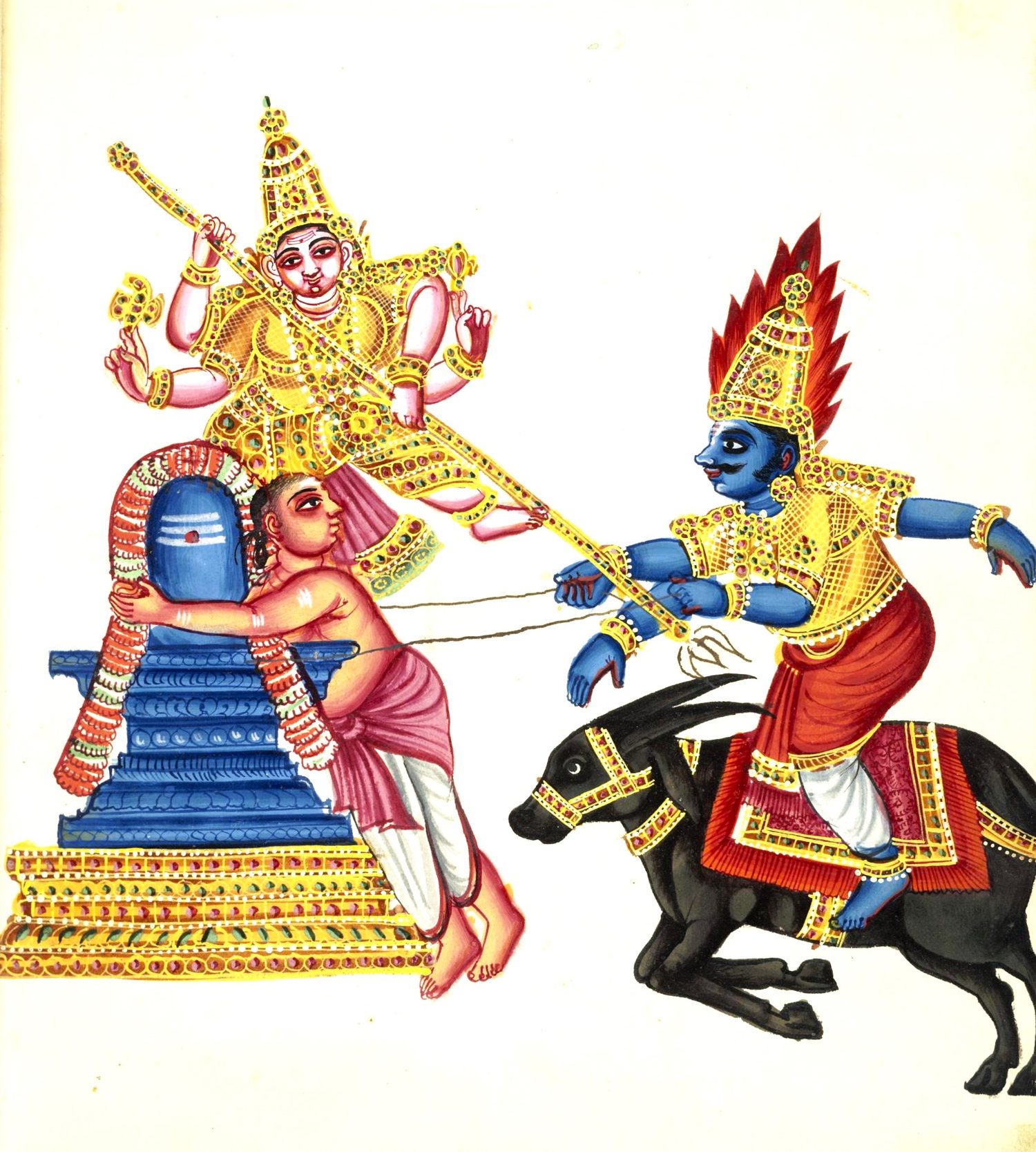
What Shaivism is शैव धर्म क्या है
Shaivism is the name for the traditions that worship Shiva as the supreme reality. It is one of the great streams of Hinduism, alongside the worship of Vishnu and of the Goddess. Its followers are called Shaivas.
Shaiva schools differ widely. Some hold that the soul and Shiva are always distinct; others that they are finally one. Some follow the Vedas alone; many also follow the Agamas or Tantras, texts of temple ritual, initiation and yoga. Most share the lingam as Shiva's sign, the Panchakshara mantra, ash and rudraksha, and a deep respect for the guru.
Scholars often divide the older schools into an "outer path" of ascetic orders and a "path of mantras" based on the Agamas. Below are the main branches, from the earliest orders to living communities today.
Pashupata: the first order पाशुपत
The Pashupatas are the earliest Shaiva order we know by name. Their founder is remembered as Lakulisha, "the lord with the club", who scholars place roughly in the 1st–2nd century CE, perhaps in Gujarat. Later tradition counted him as an avatar of Shiva.
The Pashupata Sutra taught that souls are pashu, bound cattle, and Shiva is Pashupati, their lord who frees them. Ascetics smeared themselves with ash, lived near temples and sometimes behaved strangely in public, inviting scorn so that pride would burn away. Images of Lakulisha, seated with a club, are found from Gujarat to Odisha.
Lakulisha लकुलीश
Founding teacher of the Pashupatas, shown seated with a club. His four disciples are said to have started four lineages.
Pashupata Sutra
The core text of the order, laying out five stages of the ascetic's path toward union with Shiva and freedom from suffering.
Lakulisha's dates and birthplace are estimates drawn from inscriptions and later texts.
Kapalikas and Kalamukhas कापालिक और कालामुख
The Kapalikas were ascetics who modelled their lives on Bhairava, the fierce form of Shiva who wandered carrying a skull bowl after cutting off Brahma's fifth head. They lived near cremation grounds as a vow of penance. Most of what we know of them comes from plays and from critics, so the picture is partial and often hostile.
The Kalamukhas, an offshoot of the Pashupatas, were very different in public life. Inscriptions from Karnataka, roughly the 10th–13th centuries, show them running large temples and centres of learning. Both orders had faded by around the 14th century, and parts of their ways may have passed into later ascetic groups.
These were historical orders; sources about them are limited and frequently written by opponents.
Shaiva Siddhanta शैव सिद्धांत
Shaiva Siddhanta is the school of the Agamas, the twenty-eight principal scriptures of Shaiva temple ritual. It began in north India, with Sanskrit teachers in Kashmir such as Sadyojyoti and later Ramakantha, and then flourished in Tamil Nadu, where it became the main theology of the great temples.
It teaches three eternal realities: pati, the lord; pashu, the soul; and pasha, the bonds of ignorance, karma and illusion. By Shiva's grace, through ritual, devotion and knowledge, the soul is freed and becomes like Shiva, though not identical to him. In Tamil the school took its classic form in Meykandar's Shivajnanabodham.
The Agamas आगम
Texts on temple building, image making, festivals, initiation and daily puja. Priests in south Indian Shiva temples still follow Agamic rules.
Meykandar मेय्कण्डार्
Author of the Shivajnanabodham, twelve short Tamil verses that sum up Siddhanta. It is the founding text of the Tamil school.
Umapati Shivacharya
Priest and teacher at Chidambaram who completed the fourteen Meykanda Shastras, the Tamil Siddhanta canon.
Kashmir Shaivism (Trika) काश्मीर शैव दर्शन
In Kashmir, between roughly the 9th and 11th centuries, a brilliant line of teachers built a non-dual Shaiva philosophy. For them all reality is Shiva's own consciousness, shining and knowing itself. The world is not an illusion but Shiva's free play, and liberation is recognising one's true self as Shiva.
Tradition says Vasugupta found the Shiva Sutras inscribed on a rock on Mahadev mountain, near Srinagar, in the early 9th century. Later came the Pratyabhijna, or recognition, school of Somananda and Utpaladeva. The tradition is often called Trika, after its triad of goddesses and its threefold vision of Shiva, Shakti and the individual.
Vasugupta वसुगुप्त
Received the Shiva Sutras, seventy-seven aphorisms that open with "Consciousness is the Self". Tradition credits him with the Spanda teaching too.
Utpaladeva
Author of the Ishvarapratyabhijna Karika, the root text of recognition philosophy, and of devotional hymns to Shiva.
Abhinavagupta अभिनवगुप्त
Philosopher, tantric master and theorist of art. His Tantraloka is a vast summary of Shaiva practice; he also shaped Indian aesthetics through rasa theory.
Kshemaraja
Disciple of Abhinavagupta. His Pratyabhijnahridayam, a short "heart of recognition", is still the usual first book for students.
Veerashaiva and Lingayat वीरशैव और लिंगायत
In 12th-century Karnataka, the poet and minister Basava gathered a movement of devotees who wore a personal lingam, the ishtalinga, on their bodies and worshipped Shiva directly. They questioned caste, temple ritual and the priest's monopoly, and spoke of work as worship.
The movement's saints wrote vachanas, short and fierce poems in plain Kannada. Today the community is large in Karnataka and nearby states. Its religious leaders, the Jangamas, serve its maths. Kedarnath's chief priest, the Rawal, traditionally comes from this Veerashaiva Jangam tradition of Karnataka and keeps his seat at Ukhimath in winter.
Basava (Basavanna) बसवण्णा
Chief minister to the Kalachuri king Bijjala. Founded the Anubhava Mantapa, a hall for open spiritual debate, and wrote hundreds of vachanas.
Allama Prabhu
Mystic poet who presided over the Anubhava Mantapa in tradition. His vachanas are riddling and austere.
Kedarnath Rawal रावल
The head priest of Kedarnath, from the Veerashaiva Jangam community. Daily puja is done by priests under his authority.
Whether Lingayats form a separate religion or a Shaiva sect is a live public debate; Veerashaiva and Lingayat are sometimes used as distinct terms.
The Nath sampradaya नाथ संप्रदाय
The Naths are yogis who trace their line to Shiva as Adinath, the first lord, and to the great teachers Matsyendranath and Gorakhnath. They are linked with hatha yoga, the discipline of breath, posture and inner energy, and with the ideal of a body made perfect and free.
Nath yogis are known for large earrings, which give them the name Kanphata, "split-eared". Their monasteries and dhunis, sacred fires, are found across north India and Nepal, and Himalayan folk songs remember them well. The Gorakhnath math at Gorakhpur is among the most famous.
Matsyendranath मत्स्येन्द्रनाथ
Revered as the first human guru of the line. Legend says he overheard Shiva teaching Parvati while in the form of a fish. Honoured in Nepal as well.
Gorakhnath गोरखनाथ
Disciple of Matsyendranath and organiser of the order. Many hatha yoga texts are attributed to him, along with songs in early Hindi.
Dates for the early Nath gurus are uncertain; scholars give wide ranges.
Dashanami and Smarta दशनामी और स्मार्त
Adi Shankaracharya, by tradition, organised renunciants into the Dashanami, or "ten names", order: Giri, Puri, Bharati, Saraswati, Tirtha, Aranya, Vana, Parvata, Sagara and Ashrama. Their monks wear ochre and follow Advaita Vedanta. Tradition links them with four maths: Sringeri, Dwarka, Puri and Jyotirmath, the last near Joshimath in Garhwal.
Smartas are householders who follow Shankara's teaching and worship five deities, Shiva, Vishnu, Devi, Surya and Ganesha, often with a sixth, Skanda. Many Dashanami monks give special devotion to Shiva, and Naga sannyasis of the Dashanami akharas are a famous sight at the Kumbh.
Historians date the full organisation of the Dashanami order and the four maths to centuries after Shankara.
The sixty-three Nayanars तिरसठ नायनार
Between roughly the 6th and 9th centuries, Tamil poet-saints called Nayanars travelled from temple to temple, singing of Shiva in love and longing. Their number is fixed at sixty-three. They came from every caste: kings and potters, hunters and women, priests and outcasts.
Their hymns were collected into the Tirumurai, the Tamil Shaiva canon, in twelve books. The first seven, the Tevaram, hold the hymns of the three great singers. Sekkizhar's Periya Puranam of the 12th century tells all their lives. The hymns are still sung in Tamil temples by oduvars, temple singers.
Appar (Tirunavukkarasar) अप्पर
Became a Jain monk in youth, then returned to Shiva. His hymns form books 4–6 of the Tirumurai. Tradition says he converted the Pallava king Mahendravarman.
Sambandar (Tirujnana Sambandar) सम्बन्दर
Tradition says Parvati fed him milk of wisdom as a child, and he began singing at once. His hymns form books 1–3 of the Tirumurai.
Sundarar सुन्दरर
Spoke to Shiva as a friend. His hymns form book 7 of the Tirumurai, and his list of devotees became the basis of the sixty-three.
Manikkavasagar माणिक्कवाचकर्
Minister to a Pandya king who left office for Shiva. His Tiruvasagam, book 8 of the Tirumurai, is among the most loved Tamil devotional poems.
Karaikkal Ammaiyar
One of three women Nayanars and among the earliest. She sang of Shiva dancing in the cremation ground.
Manikkavasagar is traditionally counted beside the Nayanars but is not one of the sixty-three; his date is debated.
Lal Ded (Lalleshwari) लल्लेश्वरी
Lal Ded was a Kashmiri mystic of the 14th century, roughly 1320–1390. Tradition says she left an unhappy marriage, took a guru and wandered as a renunciant. Her short poems, called vakhs, are among the earliest works in the Kashmiri language.
Her verses speak of finding Shiva within, beyond ritual and outer show, in the spirit of Kashmir Shaivism. Kashmiri Hindus and Muslims both love and quote her, and her sayings are still part of everyday speech in the valley.
Lalleshwari लल्लेश्वरी
Called Lalla, Lal Ded or Lal Arifa. Her vakhs survive through oral tradition and were written down centuries later.
Akka Mahadevi अक्क महादेवी
Akka Mahadevi was a 12th-century poet-saint of Karnataka and a part of the Veerashaiva movement. She called Shiva Chennamallikarjuna, "the lord white as jasmine", and spoke of him as her only true husband.
Tradition says she left her home and a royal marriage and walked to Kalyana, where Basava and Allama Prabhu received her. She ended her life in the forests of Srisailam. Her vachanas are bold and tender, and she is honoured as a pioneer of women's voices in Kannada literature.
Akka Mahadevi अक्क महादेवी
About 430 vachanas are attributed to her, each signed with the name Chennamallikarjuna.
Sources
- Flood, An Introduction to Hinduism (1996), ch. 7 "Saiva and Sakta Traditions"
- Sanderson, "Saivism and the Tantric Traditions", in The World's Religions (1988)
- Davis, Ritual in an Oscillating Universe: Worshipping Siva in Medieval India (1991)
- Lorenzen, The Kapalikas and Kalamukhas (1972)
- Dyczkowski, The Doctrine of Vibration (1987)
- Peterson, Poems to Siva: The Hymns of the Tamil Saints (1989)
- Ramanujan, Speaking of Siva (1973)
- Briggs, Gorakhnath and the Kanphata Yogis (1938); White, The Alchemical Body (1996)
- Sekkizhar, Periya Puranam (12th c.)
- Wikipedia (cross-check): Pashupata Shaivism; Shaiva Siddhanta; Kashmir Shaivism; Abhinavagupta; Lingayatism; Nath; Dashanami Sampradaya; Nayanars; Lal Ded; Akka Mahadevi; Kedarnath Temple
Traditional accounts are presented as tradition. Dates are approximate ranges used by scholars.