Trishul त्रिशूल
The trident. Its three points are read as the three gunas, sattva, rajas and tamas, and as creation, preservation and dissolution. Shiva holds all three in one hand.
महादेव · देवों के देव
Ascetic and householder, destroyer and protector, the fire and the stillness. Fifteen chapters on the god of the Himalaya, the one the five Kedars are built for.
अध्याय १Who is Shiva
Shiva is the destroyer of the Hindu trinity, though what he destroys is ignorance and ego, so that something new can begin. He is the ascetic of the mountains and the householder with Parvati and their sons, the god of yogis and of ordinary people. He is easily pleased by simple devotion and terrifying in his anger.
His home is the Himalaya. Kailash is his seat, Parvati is the daughter of the mountain king Himavat, and Garhwal, the land of Kedar, is where the Puranas place his most sacred shrines. To walk the Panch Kedar is to walk into his landscape.
He brings the worlds into being.
He sustains order and comes down to earth as his avatars when dharma is in danger.
He dissolves what has run its course, so that creation can begin again. For his devotees he is all three in one, the beginning and the end.
अध्याय २Panchakshara · Om Namah Shivaya
ॐ
नमःशिवाय
Earthपृथ्वीNa
Earth — what holds and sustains. The ground the pilgrim walks on, from Gaurikund to the snowline.
WaterजलMah
Water — what flows and purifies. The Mandakini, the Alaknanda, the Vaitarani, and Ganga caught in his hair.
Fireअग्निShi
Fire — what transforms. The third eye, the eternal flame of Triyuginarayan, and the aarti lamp at dusk.
AirवायुVaa
Air — what moves and breathes. The wind across the bugyals, and the thinning breath at 3,500 metres.
SpaceआकाशYa
Space — what contains everything. The open sky above Chandrashila, where the peaks stand in silence.
Om Namah Shivaya
“I bow to Shiva.” Five syllables, the Panchakshara, the oldest and simplest prayer to him. Tradition links each one to an element of the world. Five syllables, like five shrines. Scroll to light them one by one.
अध्याय ३The pillar of light · लिंगोद्भव
Once Brahma and Vishnu argued over which of them was the greater. As they quarrelled, a pillar of blazing light split the darkness between them. It had no visible beginning and no end.
They agreed that whoever found its end would be the greater. Brahma became a swan and flew upward. Vishnu became a boar and dug downward. For ages they searched and found nothing.
Vishnu returned and admitted he had failed. Brahma claimed he had reached the top, and offered a ketaki flower as false witness. Then the pillar opened and Shiva stepped out of the light.
He honoured Vishnu’s truthfulness. He declared that Brahma would have no temples of his own, and that the ketaki flower would never be offered to Shiva. This infinite column of light, the jyotirlinga, is what every Shiva lingam remembers.
Shiva Purana · Linga Purana
अध्याय ४Twelve Jyotirlingas
Twelve shrines across India where Shiva is said to have appeared as the pillar of light. Kedarnath is the northernmost and the highest. Here they are drawn as a constellation at their true positions. Choose a light.
अध्याय ५The names of Shiva
The Shiva Sahasranama gives him a thousand names, and each one is a way into who he is. Hover over or tap a name to read its meaning.
अध्याय ६Symbols of Shiva
Choose a symbol on the ring of fire. They change by themselves every few seconds.
The trident. Its three points are read as the three gunas, sattva, rajas and tamas, and as creation, preservation and dissolution. Shiva holds all three in one hand.
The small hourglass drum that keeps the rhythm of creation. Tradition says the sounds of Sanskrit grammar, the fourteen Maheshwara Sutras, came from its beat at the end of his dance.
The eye of inner sight, which sees beyond appearances. When it opened in anger, it burned Kamadeva, the god of desire, to ash.
Shiva wears the waxing crescent in his hair. It is the moon he saved from Daksha’s curse, a sign that time itself rests on him.
When Bhagiratha’s prayers brought Ganga down from heaven, her fall would have shattered the earth. Shiva caught her in his matted hair and let her flow gently. That is why the rivers of Garhwal are sacred.
The serpent king coiled around his neck, the same Vasuki used as the rope in the churning of the ocean. He stands for mastery over fear and death.
The blue throat. Shiva drank the halahala poison that rose from the churning ocean to save the worlds. It is the form worshipped at Rudranath.
“The eyes of Rudra”. These seeds are said to have formed from Shiva’s tears, and devotees wear them as prayer beads.
Sacred ash, worn as three lines on the forehead (tripundra). It is a reminder that everything returns to ash, and that only the spirit remains.
The bull who waits outside every Shiva temple, facing the sanctum. He is the model of devotion, and some whisper their prayers into his ear. At the Panch Kedar, Shiva himself took the form of a bull.
अध्याय ७Nataraja · नटराज
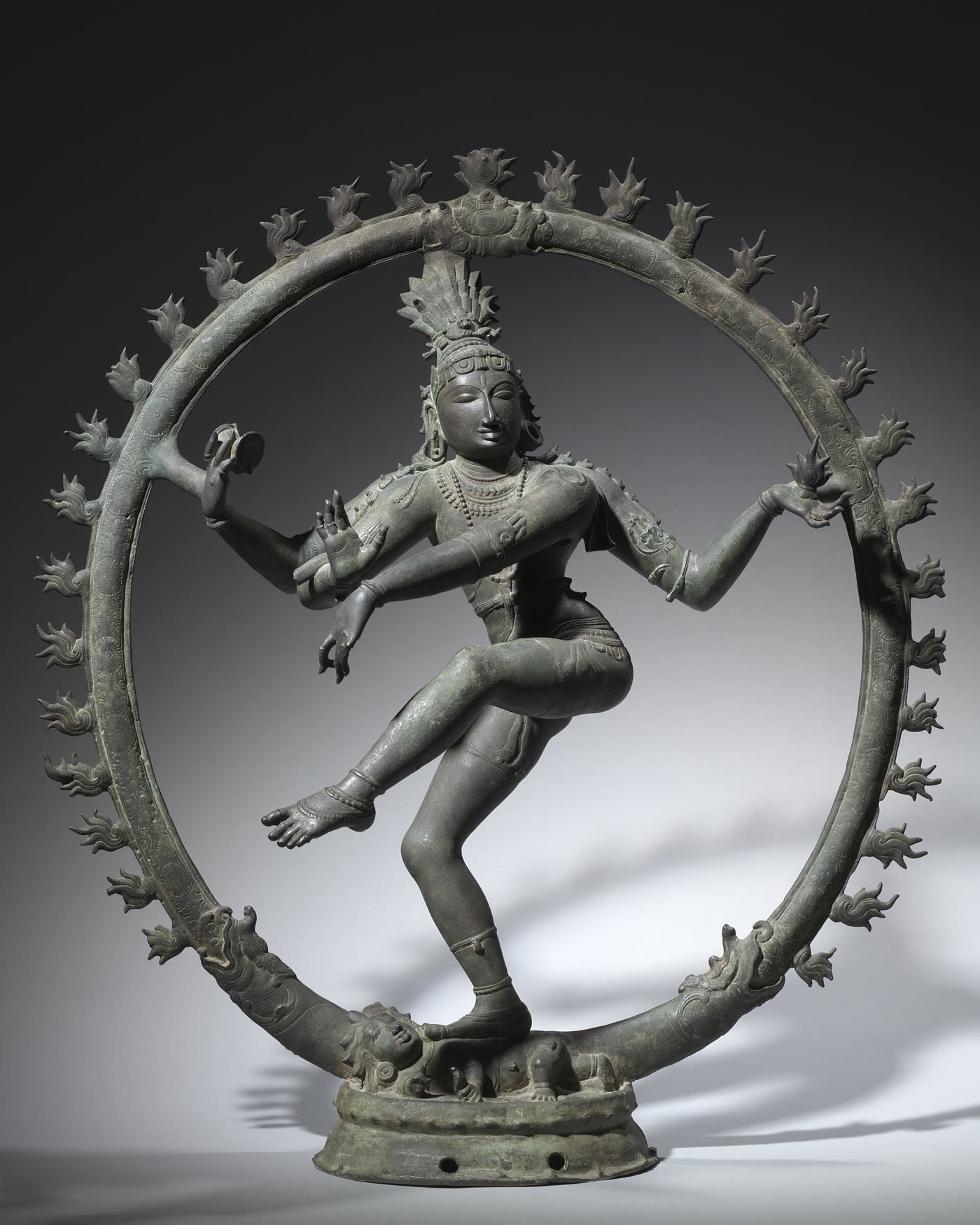
The Ananda Tandava, the dance of bliss, is the whole of Shaiva philosophy in one image: creation, preservation, dissolution, concealment and grace. Choose a point on this 900-year-old Chola bronze to read its meaning.
01 / 10
The ring of flames is the universe itself: the cycle of birth, life and dissolution that the dance keeps turning.
02 / 10
The upper right hand beats the drum. Its sound is the first vibration from which creation begins.
03 / 10
The upper left hand holds fire, the force that dissolves the universe at the end of an age. Creation and destruction are balanced in his hands.
04 / 10
The front right hand is raised, palm open: “Do not fear.” Even amid the dance of destruction, the devotee is protected.
05 / 10
The front left hand falls across the body like an elephant’s trunk and points to the raised foot.
06 / 10
The raised foot offers moksha, liberation from the cycle of rebirth, to anyone who comes to it.
07 / 10
The dwarf crushed under the right foot is Apasmara, ignorance and forgetfulness. He is held down but not killed, because ignorance must always be overcome again.
08 / 10
Amid flame and motion the face is perfectly still. The dancer is untouched by the dance.
09 / 10
The headdress holds his matted locks, often with the crescent moon and a tiny figure of Ganga. In fuller images the locks fly outward with the speed of the dance.
10 / 10
The dance rises from a lotus, the symbol of purity that grows out of mud. This bronze was cast in the Chola kingdom of South India about 900 years ago.
अध्याय ८The family of Kailash
Daughter of the mountain king Himavat. After long penance she won Shiva as her husband, and they were married at Triyuginarayan, near Kedarnath. She is Shakti, his energy. Without her, the tradition says, Shiva is shava, a corpse.
Their elder son, as told in the north. He is the remover of obstacles and is worshipped before every undertaking. Parvati shaped him from earth, and Shiva gave him his elephant head.
Their warrior son, Skanda or Murugan, born to defeat the demon Taraka. Kartik Swami temple, above Rudraprayag, is one of his few shrines in the north.
The bull, his mount and gatekeeper. Nandi sits facing the sanctum in every Shiva temple, the model of patient devotion.
Shiva’s first wife, Daksha’s daughter. She gave up her body in the fire of her father’s yagna. Shiva’s grief became the wild tandava, and she was reborn as Parvati.
अध्याय ९Great stories of Shiva
१Bhagavata · Vishnu Purana
The gods and demons churned the ocean of milk for amrita, the nectar of immortality. They used Mount Mandara as the churning rod and the serpent Vasuki as the rope.
The first thing to rise was halahala, a poison that could burn all three worlds. Only Shiva could take it. He drank it, and Parvati pressed his throat so it would go no further. The poison stayed there and turned his throat blue: Neelkanth.
२Ramayana · Bhagavata
King Bhagiratha did penance to bring Ganga down from heaven, so that she could free the souls of his ancestors. But her fall would have shattered the earth.
Shiva stood beneath the sky and caught her in his matted hair. He let her out in gentle streams. One of them is the Bhagirathi, which meets the Alaknanda at Devprayag to become the Ganga.
३Shiva Purana
Daksha held a great sacrifice and insulted Shiva by leaving him out. Sati went alone, and when her husband was mocked she gave up her body in the sacred fire.
In his grief and rage Shiva created Virabhadra, who destroyed the yagna. Then he wandered the worlds carrying Sati’s body, and his dance of sorrow shook creation. Where parts of her body fell, the Shakti Peethas arose.
४Shiva Purana · Kumarasambhava
The gods needed a son of Shiva to defeat the demon Taraka, but Shiva was lost in meditation after Sati’s death. They sent Kamadeva, the god of love, to wake desire in him for Parvati.
Kama’s flower-arrow struck, and Shiva’s third eye opened and burned him to ash. Rati, Kama’s wife, wept, and Shiva promised that love would live on without a body. Parvati then won Shiva through tapasya alone.
५Markandeya Purana · Shiva Purana
The boy Markandeya was fated to die at sixteen. When Yama came with his noose, the boy wrapped his arms around the lingam and would not let go.
Yama’s noose fell over both of them. Shiva burst out of the lingam in fury, struck Yama down and made the boy immortal. That is why Shiva is Mrityunjaya, the conqueror of death. Tungnath’s winter seat at Makkumath is named after this sage.
६Mahabharata · Shiva Purana
Three demon brothers ruled three flying cities, of gold, silver and iron, which lined up only once in a thousand years. Only a single arrow at that moment could destroy them.
The earth became Shiva’s chariot, the sun and moon its wheels, Mount Meru his bow and Vishnu his arrow. When the cities aligned, Shiva smiled, and they burned. Some tellings say a single smile was enough.
७Ramayana · Shiva Purana
Ravana, proud of his strength, tried to uproot Mount Kailash. Shiva pressed down gently with one toe and trapped him beneath the mountain.
Ravana sang Shiva’s praises in pain for a thousand years, and that song is remembered as the Shiva Tandava Stotram. Shiva forgave him and gave him the sword Chandrahas.
८Kedarkhand (Skanda Purana)
After the Mahabharata war, the Pandavas sought Shiva’s forgiveness, but he hid from them as a bull in the Garhwal hills. Bhima recognised him, and the bull dived into the earth.
Its hump stayed at Kedarnath. The arms, face, navel and hair came up at the other four Kedars, and the head at Pashupatinath. Those five places are where this website begins.
Read all the legends of the five Kedars →अध्याय १०Forms of Shiva
केदारेश्वर
Lord of Kedar. The Jyotirlinga of the high Himalaya, and the first of the Panch Kedar.
नटराज
King of dancers. His tandava creates and dissolves the universe within a ring of fire.
अर्धनारीश्वर
Half Shiva, half Parvati, showing that the two are one. There is a shrine to this form at Guptkashi.
नीलकंठ
The blue-throated one who drank the poison to save the world. He is worshipped at Rudranath.
दक्षिणामूर्ति
The silent teacher facing south. He teaches through stillness.
भैरव
The fierce guardian. As Bhairavnath he watches over Kedarnath through the winter.
पशुपति
Lord of all living beings. In tradition, the head of the bull form came up at Pashupatinath in Nepal.
रुद्र
The roaring storm god of the Vedas. The Shri Rudram hymn, which praises him, holds the words “namah shivaya”.
भोलेनाथ
The innocent lord, easily pleased by simple devotion. A leaf, some water and a true heart are enough.
अध्याय ११Mahamrityunjaya mantra
ॐ त्र्यम्बकं यजामहे सुगन्धिं पुष्टिवर्धनम्। उर्वारुकमिव बन्धनान् मृत्योर्मुक्षीय माऽमृतात्॥
Om tryambakam yajāmahe sugandhim puṣṭivardhanam, urvārukam iva bandhanān mṛtyor mukṣīya māmṛtāt
“We worship the three-eyed one, fragrant, who nourishes all beings. As a ripe cucumber is freed from its vine, may he free us from death, and not from immortality.”
Rig Veda 7.59.12 · the mantra of the conqueror of death, chanted for healing and protection
अध्याय १२How to worship Shiva
He is Bholenath, the easily pleased. These are the traditional offerings at a Shiva lingam, at home or in the high temples.
Tradition says some things are not offered to Shiva: ketaki flowers (because of the lie in the pillar-of-light story), tulsi leaves, turmeric and kumkum on the lingam itself. Customs vary by temple, so follow the priest.
The simplest and most loved offering. Pour it slowly over the lingam. In Shravan, pilgrims carry Ganga water hundreds of kilometres for this.
Three leaves of the bael tree on one stem stand for the three eyes, the trident and the three gunas. Offer them with the smooth side towards the lingam.
With sugar these make panchamrita, used in the full abhishek. At Kedarnath, pilgrims smear ghee on the rock lingam with their own hands.
Wild flowers no other god accepts. They are a reminder that Shiva takes in what the world rejects.
Ash for the forehead (tripundra), and rudraksha beads for japa of “Om Namah Shivaya”.
Walk around a Shiva lingam only halfway, then turn back. You do not step over the channel that carries away the abhishek water, which is considered sacred.
अध्याय १३Mahashivratri · महाशिवरात्रि
On the fourteenth night of the dark fortnight of Phalguna, devotees fast and stay awake. The night is divided into four praharas, each with its own abhishek. At Ukhimath, this is the night the date of Kedarnath’s opening is announced.
Abhishek with milk. The vigil begins with lamps and bhajans.
Abhishek with curd. Chanting of the Rudram and the Panchakshara.
Abhishek with ghee. The deepest hour, when Shiva is said to appear as the pillar of light.
Abhishek with honey. The fast is broken after sunrise.
The great night of Shiva, kept with fasting and an all-night vigil. On this day the priests at Ukhimath announce the date when Kedarnath will open.
The month of Shiva. Every Monday (Somvar) of Shravan is especially sacred, and pilgrims carry Ganga water to offer on the lingam.
The 13th day of each lunar fortnight, at twilight. It is said that Shiva dances at this hour.
Monday is Shiva’s day, and many devotees fast and offer water and bel leaves.
अध्याय १४Panch Kailash · पंच कैलाश
Shiva’s eternal home. Nobody climbs it; pilgrims walk around it.
Uttarakhand’s own Kailash. Snow on Om Parvat forms the shape of ॐ.
A rock pillar on the peak is worshipped as a natural lingam.
Among the hardest pilgrim treks in India.
Pilgrims gather at its sacred lake on Radhashtami.
अध्याय १५The five Kedars
॥ ॐ नमः शिवाय ॥
This website is managed by
The Office of MushroomWale.com
A free, independent guide for Panch Kedar pilgrims, prepared and maintained from Uttarakhand. Temple bookings and donations go only through official channels — this site never collects money.
Visit MushroomWale.com