Last checked 13 Oct 2026 · Prepared by the Office of MushroomWale.com · Sources listed under “In detail”.
इतिहासHistory & significance
The jata (matted locks) of Shiva — worshipped on a rock inside a cave.
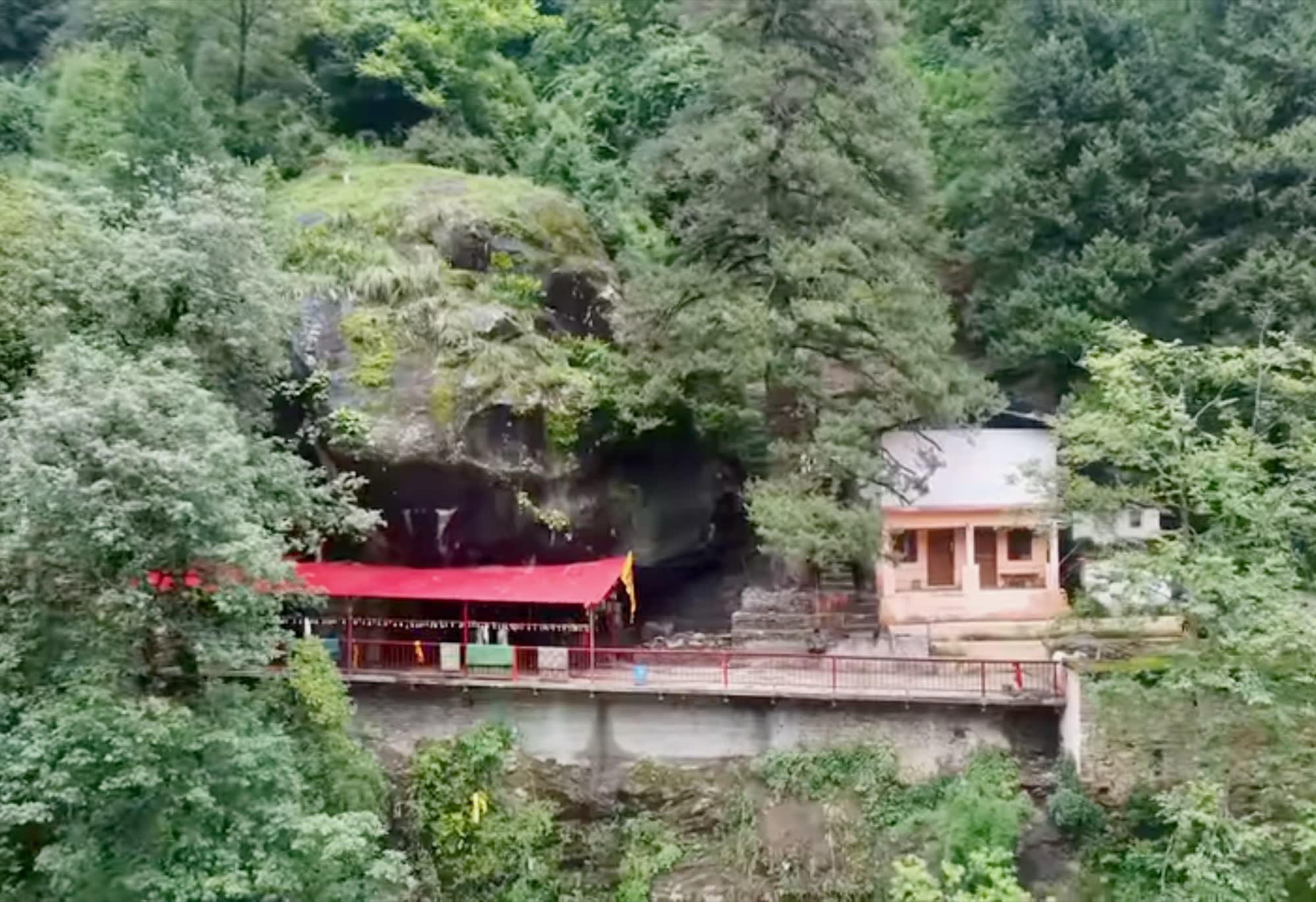
The matted hair of Shiva appeared at Kalpeshwar, and it is worshipped on a rock inside a small cave temple. You reach it over a bridge across the Kalpganga.
The sage Durvasa is said to have meditated here under the wish-fulfilling Kalpavriksha tree, which gives the shrine its name. Sage Arghya is also said to have done penance here, creating the apsara Urvashi.
Kalpeshwar was once a hard 12-km walk from Helang. A road now runs to Devgram, so it is the easiest of the five. It is also the natural finish of the circuit: from Helang the highway continues to Joshimath and Badrinath.
Important points
Only Panch Kedar open throughout the year
Cave temple; Shiva’s jata worshipped on a rock
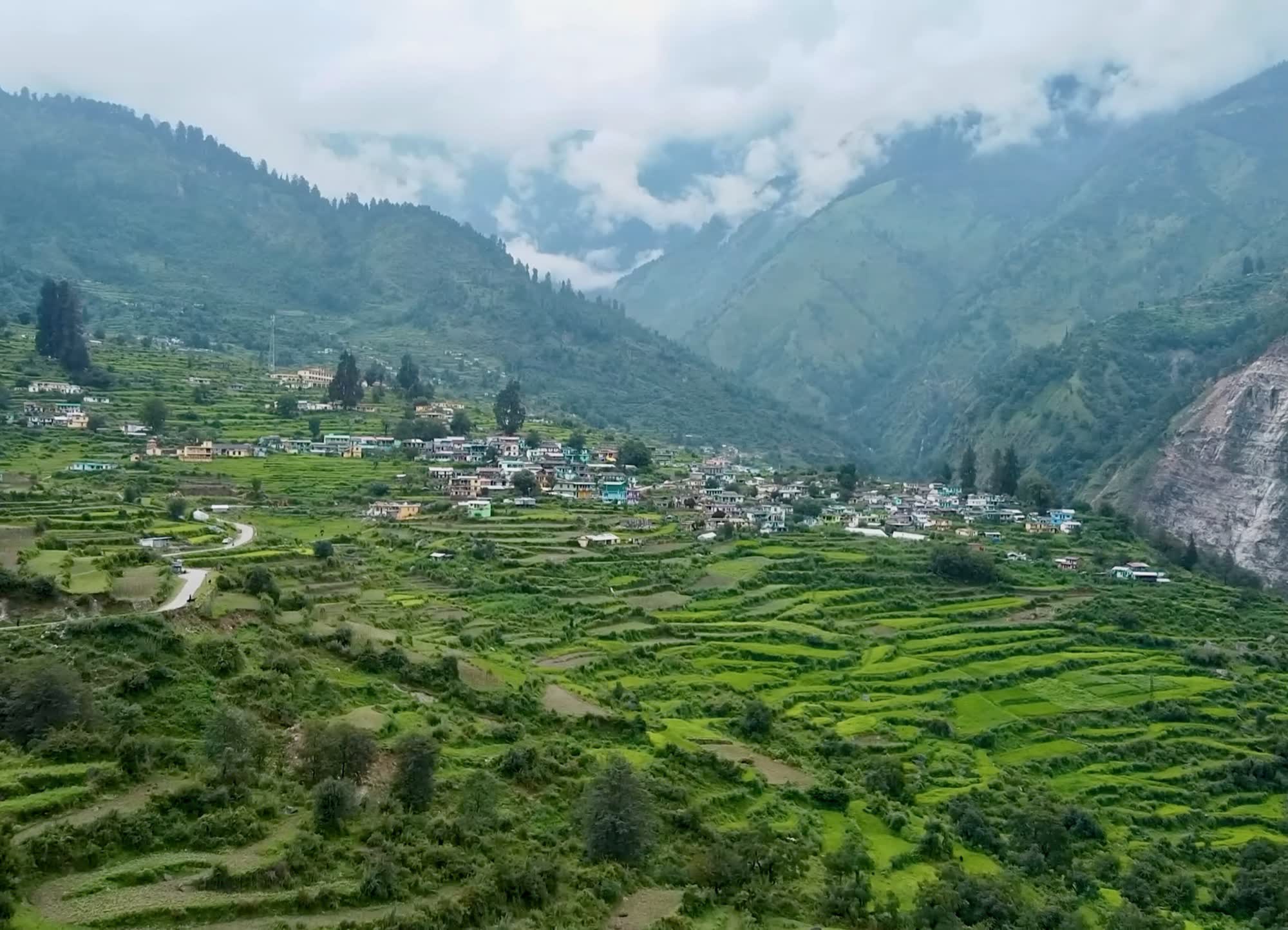
Urgam valley — terraced fields and apple orchards
Dhyan Badri (one of the Sapta Badri) in the same valley
विस्तारIn detail
Kalpeshwar, in full detail
The building and its worship, the festivals, the trail stage by stage, month-by-month weather, facilities on the way, and the customs to know.
Kalpeshwar is a small stone temple built against a rock face and reached through a short cave passage. Inside, Shiva’s jata is worshipped on the natural rock.
It is the simplest of the five. There is no tall shikhara or large mandapa — just a modest stone shrine among the trees above the Kalpganga.
Worship runs all year, from a morning puja at sunrise to an evening aarti. There is no winter move because the temple never closes.
The priests are traditionally described as Dasnamis and Gosains, an order linked with the disciples of Adi Shankaracharya.
The temple is small and usually uncrowded. Remove shoes and leather before the cave entrance.
February–March
Mahashivratri
The main festival of the temple. Rituals continue through the day and night.
July–August
Shravan
Mondays in the month of Shravan draw local devotees. Monsoon can block the Helang–Urgam road, so check before you go.
November–March
Winter darshan
Not a festival, but a custom. When the other four Kedars are closed, pilgrims come here for Panch Kedar darshan.
1
Devgram → Kalpganga bridge
≈ 0.3 km+50 m
A short, easy path from the road head down to the bridge.
2
Kalpganga bridge → Kalpeshwar
≈ 0.2 km+50 m
Across the bridge and a few steps up to the cave temple. Easy for almost anyone.
-4°C24°C
Jan≈ −2°C / ≈ 8°COpen. Cold; occasional snow in the valley.
Feb≈ 0°C / ≈ 10°COpen. Cold; occasional snow.
Mar≈ 3°C / ≈ 14°COpen. Warming.
Apr≈ 7°C / ≈ 18°COpen. Pleasant; orchards in blossom.
May≈ 10°C / ≈ 21°COpen. Warm days.
Jun≈ 13°C / ≈ 22°COpen. Showers from mid-June.
Jul≈ 14°C / ≈ 21°COpen. Monsoon — the road can be blocked by slides.
Aug≈ 14°C / ≈ 21°COpen. Monsoon.
Sep≈ 11°C / ≈ 20°COpen. Rain easing.
Oct≈ 6°C / ≈ 17°COpen. Clear and fresh.
Nov≈ 2°C / ≈ 13°COpen. Cold nights. Approximate.
Dec≈ −1°C / ≈ 10°COpen. Cold; check the road after snowfall.
Approximate temperatures at the temple’s altitude (night / day). These are not weather-station records.
Medical aid
No medical post at the temple. The nearest hospitals are at Joshimath and Gopeshwar.
Mobile network
Patchy in the Urgam valley. Some operators usually work around Urgam village.
ATMs & cash
No ATM in the valley. Use ATMs at Joshimath or Pipalkoti and carry cash.
Food on the trail
Small dhabas at Devgram and Urgam; meals at homestays.
Ponies / palki / porters
Not needed — the walk is only a few hundred metres.
Electricity & charging
Village homes and homestays have grid power, with occasional cuts.
Toilets
At homestays and dhabas. None at the temple itself.
Drinking water
Available at homestays and village taps. Treat stream water.
Do
Combine the visit with Dhyan Badri in Urgam.
Hire a local driver for the narrow Helang–Urgam road, especially after rain.
Carry warm clothes in winter; nights fall below freezing.
Stay a night in an Urgam homestay to see the valley properly.
Don’t
Don’t drive the valley road in heavy rain.
Don’t photograph inside the cave.
Don’t pick fruit from the orchards; they are people’s livelihoods.
Don’t leave plastic by the Kalpganga.
Can I visit Kalpeshwar in winter?
Yes. It is the only one of the Panch Kedar open all year. Check the Joshimath highway and the Helang–Urgam road after snowfall.
How far is the walk from the road?
Only a few hundred metres from Devgram, across the Kalpganga bridge. The old 12 km walk from Helang is no longer needed.
Who are the priests at Kalpeshwar?
They are traditionally described as Dasnamis and Gosains, an order linked with Adi Shankaracharya’s disciples.
Based on: Uttarakhand Tourism and Incredible India (Kalpeshwar temple pages) · Chamoli district website · Travel and route guides for the Urgam valley · Wikipedia (Kalpeshwar) for cross-checking.
कथाएँThe legends
The stories of Kalpeshwar
Traditional accounts, as told in the Puranas and by the temple communities. Versions differ from valley to valley.
The matted hair
At Kalpeshwar, the last of the five, the jata, the matted locks of Shiva, came up out of the earth. The god is worshipped on a rock inside a small cave temple, reached across the Kalpganga stream.
Ganga came down from heaven into these same locks. Shiva caught her in his hair so that the force of her fall would not shatter the earth.
Durvasa under the wishing tree
The name Kalpeshwar comes from the kalpavriksha, the wish-granting tree that rose from the churning of the ocean.
Tradition says the fiery sage Durvasa meditated beneath such a tree in this valley, and so the place became the seat of the Lord of the Wishing Tree.
Urvashi born of a sage’s penance
Another story of the Urgam valley tells of the sage Arghya, who did such fierce penance here that he created Urvashi, the most beautiful of the apsaras, the celestial dancers.
The valley is still remembered as a place where tapasya, deep spiritual discipline, could bring wonders to life.
The Kedar that never closes
Every other Kedar goes into its winter seat when the snows come. Kalpeshwar does not. Its shrine stays open all twelve months, and the worship never stops.
For pilgrims who cannot wait for summer, it is the one place where Panch Kedar darshan is possible in the depths of winter. And just down the valley lies the road to Badrinath. Many end the whole yatra there, before Vishnu, as the Pandavas are said to have done on their last journey north.
Each trail is traced from OpenStreetMap footpaths, and its height is measured every 20 m from satellite terrain data (SRTM). The hiker walks that real profile on a 3D satellite map. Speed comes from Tobler’s hiking function, adjusted for altitude, your pace and rest stops. At every step you see altitude, gradient, oxygen and temperature, and at the end the time you reach the temple.
Seat of Jyotirmath, founded by Adi Shankaracharya; winter home of Badrinath.
≈ 26 km
Badrinath
Tradition says the pilgrimage is completed with darshan of Badri Vishal.
≈ 60 km from Helang
Rudranath via Dumak
A tough multi-day route linking Kalpeshwar to Rudranath.
Alternate trek
विश्रामWhere to stay
Stays for Kalpeshwar
Homestays and guest houses at Urgam and Devgram; hotels at Helang, Pipalkoti and Joshimath.
Kalpeshwar
Urgam · Devgram · Helang
Homestays
Guest houses
Indicative / night₹800 – ₹2,500
Quiet valley stays among orchards.
Kalpeshwar
Joshimath · Pipalkoti
GMVN Tourist Rest House
Hotels
Indicative / night₹1,200 – ₹5,000
Convenient for Kalpeshwar plus Badrinath.
सुझावPilgrim tips
The Helang – Urgam road is narrow. Use a local driver after rain.
Combine it with Badrinath (≈ 60 km from Helang) for the traditional finish.
In winter, check the Joshimath highway status before you leave.
This website is managed by
The Office of MushroomWale.com
A free, independent guide for Panch Kedar pilgrims, prepared and maintained from Uttarakhand. Temple bookings and donations go only through official channels — this site never collects money.