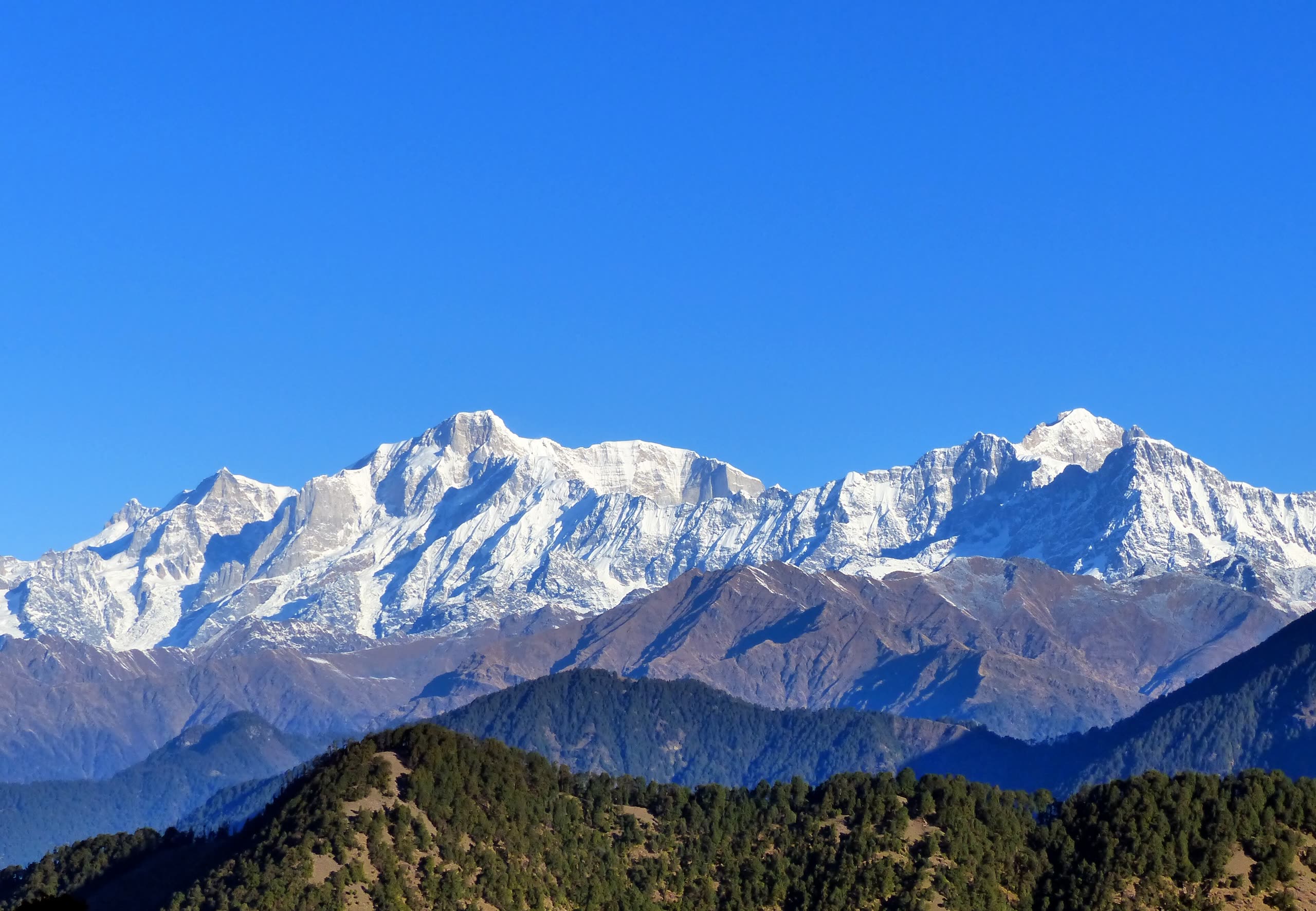
The twelve Jyotirlingas द्वादश ज्योतिर्लिंग
A Jyotirlinga is a shrine where Shiva is believed to have appeared as an endless column of light. The Shiva Purana names twelve, and a short Sanskrit hymn, the Dvadasha Jyotirlinga Smaranam (often called the Dvadasha Jyotirlinga Stotram), lists them in a single breath. Tradition holds that reciting it morning and evening wipes away the sins of seven lifetimes.
The hymn names each shrine by a region, a river or a forest rather than a modern address. That is why some of the twelve are claimed by more than one temple, as the next section explains.
सौराष्ट्रे सोमनाथं च श्रीशैले मल्लिकार्जुनम्। उज्जयिन्यां महाकालमोङ्कारममलेश्वरम्॥
saurāṣṭre somanāthaṃ ca śrīśaile mallikārjunam | ujjayinyāṃ mahākālam oṅkāram amaleśvaram ||
“Somnath in Saurashtra, and Mallikarjuna on Srishaila; Mahakala in Ujjain, and Omkara, the Amaleshvara.”
Dvadasha Jyotirlinga Smaranam, verse 1
Somnath सोमनाथ
First of the twelve, where Chandra was freed from Daksha’s curse. Raided in 1026 and rebuilt many times; the present temple on the Arabian Sea shore was consecrated in 1951.
Mallikarjuna मल्लिकार्जुन
On the Srisailam hills above the Krishna river. Shiva as Mallikarjuna shares the site with the goddess Bhramaramba, so it is counted as both a Jyotirlinga and a Shakti Peetha.
Mahakaleshwar महाकालेश्वर
The Lord of Time, and the only Jyotirlinga facing south. Famous for the bhasma aarti before dawn, when the linga is offered sacred ash.
Omkareshwar ओंकारेश्वर
On an island in the Narmada said to be shaped like Om. The hymn’s “Omkara, Amaleshvara” covers both Omkareshwar and the Mamleshwar (Amareshwar) shrine across the river.
Kedarnath केदारनाथ
The highest of the twelve, at about 3,580 m, open only from spring to Diwali. First of the Panch Kedar; our full guide is at the Kedarnath page.
Bhimashankar भीमशंकर
In the forested Sahyadri, near the source of the Bhima river. The hymn places it in “Dakini”, so temples near Guwahati in Assam and at Kashipur in Uttarakhand also claim the name.
Kashi Vishwanath काशी विश्वनाथ
Lord of the Universe in the city he never leaves. The present temple was built by Ahilyabai Holkar in 1780; its spire was gilded under Maharaja Ranjit Singh.
Trimbakeshwar त्र्यंबकेश्वर
Near the source of the Godavari at Brahmagiri, on the “banks of the Gautami” as the hymn says. Its small linga has three faces, for Brahma, Vishnu and Shiva.
Vaidyanath वैद्यनाथ
Lord of physicians, linked with Ravana’s linga. Kanwariyas carry Ganga water here each Shravan. Parli Vaijnath in Maharashtra also claims the title, from the hymn’s “Paralyam”.
Nageshwar नागेश्वर
Lord of serpents, in the hymn’s “Darukavana”, the forest of Daruka. Aundha Nagnath in Maharashtra and Jageshwar in Uttarakhand are also revered as this Jyotirlinga.
Rameshwaram रामेश्वरम्
Tradition holds that Rama worshipped Shiva here before crossing to Lanka. The Ramanathaswamy temple is known for its long pillared corridors and its sacred wells.
Grishneshwar घृष्णेश्वर
The last of the twelve, a short walk from the Ellora caves. Rebuilt in red stone by Ahilyabai Holkar in the 18th century.
The list of twelve is fixed by the hymn and the Shiva Purana (Koti Rudra Samhita); the identification of some sites is not.
Where the twelve are disputed विवादित स्थान
Three of the twelve have rival claimants, each with its own tradition and devoted pilgrims. Vaidyanath is placed at Deoghar in Jharkhand by most of North and East India, while Maharashtra honours Parli Vaijnath, reading the hymn’s “Paralyam” as Parli; Baijnath in Himachal Pradesh is a third Vaidyanath.
Nageshwar, “in Darukavana”, is placed near Dwarka in Gujarat, at Aundha in Maharashtra, or at Jageshwar near Almora, where the forest of deodar trees is read as the daruvana. Bhimashankar, “in Dakini”, is placed in the Sahyadri near Pune, near Guwahati in Assam, or at Kashipur in Uttarakhand.
Pilgrims usually follow the tradition of their own region. Many visit more than one.
No claim here is settled by history; each rests on reading the hymn’s place names.
Panch Bhoota Sthalams: the five elements पंचभूत स्थल
In South India five great temples are each held to embody one of the five elements of which the world is made. Four are in Tamil Nadu and one in Andhra Pradesh. All are celebrated in the Tamil Tevaram hymns of the Nayanar saints.
Ekambareswarar एकाम्बरेश्वर
Tradition holds that Parvati made a linga of sand under a mango tree and embraced it when the river flooded. The linga is a prithvi linga of earth, and an ancient mango tree stands in the courtyard.
Jambukeswarar जम्बुकेश्वर
On Srirangam island in the Kaveri. An underground spring keeps the floor of the sanctum moist and seeps around the linga.
Arunachaleswarar अरुणाचलेश्वर
The hill of Arunachala itself is worshipped as a column of fire. At Karthigai Deepam a great beacon is lit on its summit.
Srikalahasteeswara श्रीकालहस्तीश्वर
A lamp in the windowless sanctum is said to flicker as if in a breeze. This is also where the hunter Kannappa offered his eyes.
Chidambaram Nataraja चिदम्बरम् नटराज
Shiva dances here as Nataraja. The “Chidambara Rahasyam”, the secret, is an empty space behind a curtain, hung with golden bilva leaves, standing for formless akasha.
Panch Kedar: the five Kedars पंच केदार
In Garhwal, tradition holds that when Shiva escaped the Pandavas as a bull and sank into the earth, his body rose again in five places. These five temples are what this website is about, and each has its own full guide.
Kedarnath केदारनाथ
The hump of the bull, and a Jyotirlinga. See the Kedarnath page.
Madhyamaheshwar मध्यमहेश्वर
The navel and middle body. See the Madhyamaheshwar page.
Tungnath तुंगनाथ
The arms; the highest Shiva temple of the five. See the Tungnath page.
Rudranath रुद्रनाथ
The face, worshipped as Neelkanth. See the Rudranath page.
Kalpeshwar कल्पेश्वर
The jata, and the only one of the five open all year. See the Kalpeshwar page.
In Nepal, Doleshwar Mahadev near Bhaktapur is honoured by local tradition as the place where the bull’s head emerged.
Panch Kailash: the five Kailashes पंच कैलाश
Five Himalayan peaks are each revered as a dwelling of Shiva. Mount Kailash in Tibet is the first; the other four are in India. Our Shiva page has a fuller account of the two eastern ones.
Kailash कैलाश
The cosmic mountain itself; see the section below.
Adi Kailash आदि कैलाश
Near the Tibet border, beside Parvati Kund, with Om Parvat close by.
Kinnaur Kailash किन्नौर कैलाश
A tall rock pillar near the summit is worshipped as a natural linga.
Shrikhand Mahadev श्रीखंड महादेव
One of the hardest pilgrim treks in India, to a rock linga at over 5,000 m.
Manimahesh Kailash मणिमहेश कैलाश
Pilgrims bathe in Manimahesh lake below the peak during the Manimahesh yatra in late summer.
Kashi, the city Shiva never leaves काशी
Varanasi, ancient Kashi, “the luminous”, is said to rest on the tip of Shiva’s trishul, above the ordinary world. The Kashi Khanda of the Skanda Purana calls it Avimukta, “never forsaken”, because Shiva and Parvati never leave it.
Tradition holds that whoever dies in Kashi is granted liberation, as Shiva himself whispers the taraka mantra, the mantra that carries across, into the ear of the dying. For this reason many come here in old age, and the cremation fires on the ghats never go out.
Avimukta अविमुक्त
The “never forsaken” sacred zone, and an old name of the city’s principal linga.
Manikarnika मणिकर्णिका
The great cremation ghat. Tradition says a jewelled earring of Shiva or Parvati fell into the well here, giving the place its name.
Kashi Vishwanath काशी विश्वनाथ
The Golden Temple of Varanasi. The Kashi Vishwanath Dham corridor, opened in 2021, links the temple directly to the Ganga.
Kala Bhairava काल भैरव
Shiva’s fierce form who guards the city. Pilgrims seek his leave on arriving and departing.
Panchakroshi Yatra पंचक्रोशी यात्रा
A walking pilgrimage around the boundary of sacred Kashi, with many shrines on the way.
Pashupatinath, Nepal पशुपतिनाथ
On the banks of the Bagmati in Kathmandu stands Pashupatinath, Lord of all beings, the most sacred Shiva temple in Nepal. Its linga has four faces, with a fifth looking upward. Tradition holds that Adi Shankaracharya arranged for priests from South India to serve here, and Bhatta priests from Karnataka still perform the worship.
The temple is part of the Kathmandu Valley World Heritage Site. Only Hindus may enter the main courtyard; others watch from across the river, near the cremation ghats of Arya Ghat. Mahashivaratri brings vast crowds and many sadhus from India.
Pashupatinath पशुपतिनाथ
The main temple, with a two-tiered pagoda roof and a great golden Nandi before the western door.
Guhyeshwari गुह्येश्वरी
A Shakti Peetha a short walk downstream, honoured as the consort shrine of Pashupatinath.
Doleshwar Mahadev डोलेश्वर महादेव
Revered locally as the head of the Kedar bull, completing the Panch Kedar story.
The date of the first temple is unknown; the present building dates from the late 17th century.
Amarnath, the ice lingam अमरनाथ
High in the mountains of Kashmir, at about 3,880 m, a cave holds a lingam of ice that forms from dripping water. It grows and shrinks with the seasons, and in tradition with the phases of the moon. Two smaller ice forms beside it are honoured as Parvati and Ganesha.
The cave tradition says that here Shiva told Parvati the secret of immortality, the Amar Katha, and left his companions behind along the way so none would overhear. The yatra runs in the monsoon months and ends on Shravan Purnima, when the holy mace, the Chhari Mubarak, arrives from Srinagar.
The size of the ice lingam varies greatly from year to year. Local tradition credits a Muslim shepherd, Buta Malik, with finding the cave; older texts also mention it.
Kailash and Mansarovar कैलाश मानसरोवर
Mount Kailash, about 6,638 m high, in western Tibet, is the home of Shiva and Parvati. It is also sacred to Buddhists, to Jains as Ashtapada, and to the Bon religion. No one has climbed it, and pilgrims instead walk the parikrama, about 52 km around its base.
Below lie two lakes. Mansarovar, “the lake of the mind”, is fresh and said to have been formed in Brahma’s mind; bathing in it is a lifelong wish of many Hindus. Rakshas Tal beside it is salty and linked in tradition with Ravana’s penance. Indian pilgrims usually go by the Lipulekh pass or the Nathu La route.
Heights for Kailash differ slightly between surveys. Access depends on agreements between India and China and has been suspended in some years.
The 276 temples sung by the saints पाडल पेट्र स्थल
Tamil tradition honours 276 Shiva temples, the Paadal Petra Sthalams, “the places that received songs”, because the Nayanar saints Appar, Sambandar and Sundarar sang of them in the Tevaram between about the 6th and 9th centuries.
Most stand along the Kaveri in the old Chola country, but a few lie far away. Kedarnath and Kailash are both on the list, so the Tamil saints’ hymns link the temples of the far south with these Himalayan shrines.
Shakti Peethas: the Sati link शक्तिपीठ
When Sati gave up her life at Daksha’s sacrifice, Shiva carried her body across the worlds in grief. To end his sorrow, Vishnu’s discus cut it into pieces, and wherever a part fell a Shakti Peetha arose. At each one the goddess is worshipped together with a form of Shiva as Bhairava, her guardian.
The number of peethas depends on the text: lists give 4, 18, 51, 52, 64 or 108. The count of 51, matching the letters of the Sanskrit alphabet, is the most widely followed.
Kamakhya कामाख्या
On Nilachal hill, where tradition says the yoni fell. The great Ambubachi Mela marks the goddess’s yearly menstruation.
Kalighat कालीघाट
Where toes of Sati’s right foot are said to have fallen, and the temple from which Calcutta may take its name.
Hinglaj हिंगलाज
A cave shrine in the desert hills, linked with the crown of Sati’s head, and visited by Hindus of Pakistan in a yearly pilgrimage.
Jwalamukhi ज्वालामुखी
No image is worshipped, only natural flames that burn from the rock. Sati’s tongue is said to have fallen here.
Vishalakshi विशालाक्षी
Near Manikarnika in Kashi, linked with Sati’s earring.
Lists differ not only in number but on which body part fell where; the identifications here follow the most common tradition.
Shiva in Southeast Asia (historical) दक्षिण-पूर्व एशिया में शिव
From early in the first millennium CE, kingdoms across Southeast Asia adopted Shiva worship, often linking the king to Shiva through a royal linga. These are historical sites, today mostly monuments rather than living temples.
Prambanan प्रम्बनन
Built around 850 CE, its tallest central shrine is for Shiva, flanked by Brahma and Vishnu. A World Heritage Site and still used for festivals by Indonesian Hindus.
Angkor, early Shaiva phase अंगकोर
Jayavarman II founded a royal cult around 802 CE, and early temple-mountains such as Bakong and Phnom Bakheng were Shaiva. Angkor Wat itself, from the 12th century, is dedicated to Vishnu.
Mỹ Sơn मी सन
Temple complex of the Cham kings, centred on the linga of Bhadreshvara. A World Heritage Site, badly damaged in the 20th century.
Vat Phou वाट फू
A hillside temple below a peak whose natural stone pillar was worshipped as a linga, the Lingaparvata.
Dates are approximate and come from inscriptions and archaeology.
Sources
- Shiva Purana, Koti Rudra Samhita (Jyotirlingas)
- Dvadasha Jyotirlinga Smaranam (traditional Sanskrit hymn)
- Skanda Purana, Kashi Khanda and Kedara Khanda
- Tevaram hymns of Appar, Sambandar and Sundarar
- Devi Bhagavata Purana and Peetha Nirnaya (Tantrachudamani) on the Shakti Peethas
- Diana L. Eck, India: A Sacred Geography (2012)
- Diana L. Eck, Banaras: City of Light (1982)
- UNESCO World Heritage listings: Kathmandu Valley, Prambanan, My Son Sanctuary, Vat Phou
- Michael Freeman and Claude Jacques, Ancient Angkor (1999)
Traditional accounts are presented as tradition. Dates are approximate ranges used by scholars.