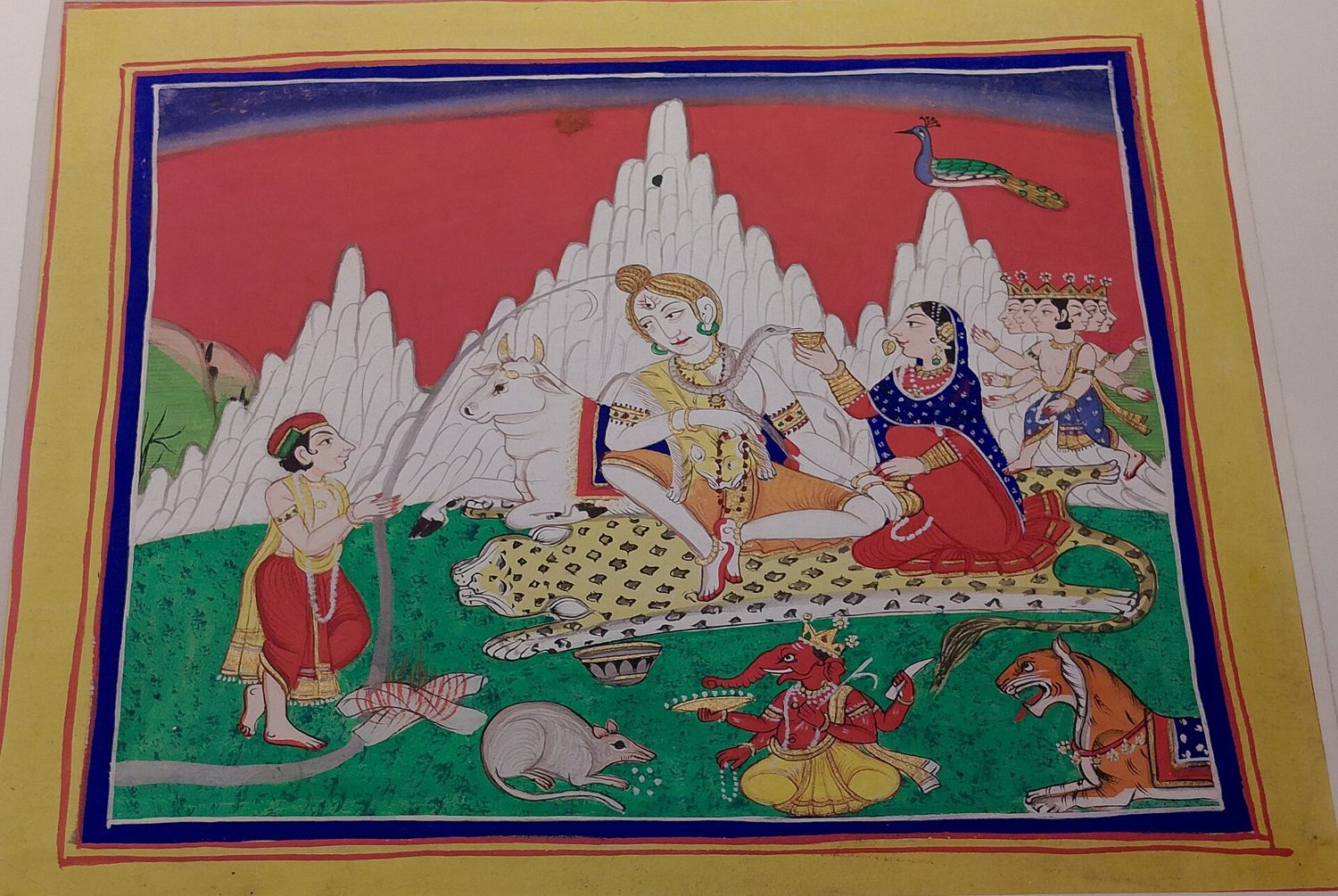
Mahashivratri: finding the date महाशिवरात्रि
Mahashivratri falls on the fourteenth day, chaturdashi, of the dark fortnight in late winter. It is one night, but it carries two month names. In the amanta calendar, where months end at the new moon, it is in Magha. In the purnimanta calendar of North India, where months end at the full moon, the same night is in Phalguna.
Panchangs choose the date on which chaturdashi is present at nishita kaal, the deep midnight hour. In the Gregorian calendar it lands between mid-February and mid-March.
Devotees fast, bathe the linga through the night and keep awake, chanting and singing until dawn. The fast is usually broken the next morning.
Krishna Chaturdashi
The 14th lunar day of the waning moon, the night before amavasya. Every month has one; this one is the "great" Shivaratri.
Nishita kaal
The midnight muhurta. The night on which chaturdashi covers it is chosen for the festival.
Jagaran जागरण
The vigil. Tradition holds that staying awake in worship on this night is worth more than any other vow.
Kedarnath date
On Mahashivratri the priests at the Omkareshwar temple in Ukhimath read the panchang and announce the day Kedarnath will open after winter.
Why this night
Different texts give different reasons: the night the pillar of fire appeared, the night of Shiva’s marriage to Parvati, or the night he drank the poison.
The site’s Mahashivratri page covers the four prahars of worship; this section covers the calendar.
Mahashivaratri at Pashupatinath पशुपतिनाथ
In Kathmandu, Mahashivaratri is a national festival. Hundreds of thousands of pilgrims from Nepal and India come to the Pashupatinath temple on the Bagmati, and ash-smeared sadhus gather in its grounds for days before.
Fires are lit through the night against the late-winter cold, and the day is also observed as Nepal Army Day. For pilgrims of the Panch Kedar the link is close: tradition holds that the head of the bull form of Shiva appeared at Pashupatinath.
Sadhus’ gathering
Ascetics from across the subcontinent camp in the temple forests. The government and trusts arrange their food and fuel.
Night bonfires
Families light fires in courtyards and on street corners, a custom tied to the cold of the season and to Shiva as lord of fire.
Nepal Army Day
The army marks its day on Mahashivaratri with a parade in Kathmandu.
Shravan, the month of Shiva श्रावण मास
Shravan, or Sawan, the monsoon month of July–August, is held sacred to Shiva. Tradition links it to the churning of the ocean: the poison is said to have been drunk in this season, and water poured on the linga cools him.
Because of the two calendars, North India starts Shravan about two weeks before Maharashtra, Gujarat and the South. Every Monday of the month is a day of fasting and abhishek.
Shravan Somvar सावन सोमवार
The Mondays of Shravan. Temples open early and queues for jal abhishek stretch out of the gate.
Shravan Shivaratri
The monthly Shivaratri of Shravan, the main day for Kanwar water to be offered in the north.
Hariyali Teej
Women fast and swing in green clothes, remembering Parvati’s penance and her union with Shiva.
Shravani Mela
A month-long fair at Baidyanath Dham, Deoghar, with pilgrims carrying water on foot from Sultanganj on the Ganga, roughly a hundred kilometres away.
Kedarnath in Shravan
The monsoon makes the road hard, but the temple stays open and the Mondays draw local devotees.
The Kanwar Yatra कांवड़ यात्रा
In Shravan, millions of pilgrims called kanwariyas, mostly dressed in saffron, walk to the Ganga, fill pots with its water and carry them back on a shoulder pole, the kanwar, to pour on the linga of their home temple. Many walk barefoot for days.
The pots are not supposed to touch the ground on the way. The largest stream goes to Haridwar and back to towns across western Uttar Pradesh, Haryana, Delhi and Rajasthan. Tradition remembers Parashurama, or in some tellings Ravana, as the first to carry Ganga water to Shiva.
Haridwar
The main source of water for the northern yatra. Highways are given over to walkers in the last days.
Gaumukh and Gangotri
Some kanwariyas go to the source of the Bhagirathi for water considered purest of all.
Neelkanth Mahadev
A temple above Rishikesh where tradition says Shiva drank the poison. It is a key stop for kanwariyas.
Dak Kanwar
Relay teams who run without stopping, passing the water from hand to hand.
Khadi Kanwar
The "standing" kanwar, which must never be put down, so walkers travel in pairs.
Sultanganj to Deoghar
The eastern route, about a hundred kilometres on foot to Baidyanath.
Pradosh: the twilight vow प्रदोष व्रत
Pradosh falls on the trayodashi, the 13th lunar day, of both fortnights, so it comes twice a month. Worship is done in the pradosh kaal, the time around sunset, often reckoned as about an hour and a half before and after.
The Shiva Purana and the Skanda Purana praise this hour. Popular tradition says Shiva dances at twilight and all the gods attend. In South Indian temples, pradosham worship begins with abhishek to Nandi, and Shiva is taken round the temple on the bull.
Soma Pradosh
When pradosh falls on a Monday. Considered especially fruitful for Shiva’s worship.
Bhauma Pradosh
Pradosh on a Tuesday, linked with relief from debts and illness in popular belief.
Shani Pradosh
Pradosh on a Saturday, popular among those seeking relief from the influence of Saturn.
The fast
Many fast through the day and eat only after the twilight puja.
Masik Shivaratri मासिक शिवरात्रि
Every month has its own Shivaratri on Krishna Chaturdashi, the night before the new moon. Masik Shivaratri is kept by devotees who wish to observe Shiva’s night all through the year, with a fast, an evening abhishek and chanting.
Tradition says a vow begun on Mahashivratri can be continued on each Masik Shivaratri for a year.
Twelve nights
One in each lunar month, with Mahashivratri the greatest and Shravan’s the most crowded in the north.
At home
A simple puja with water, bel leaves and a lamp, and the Panchakshara repeated.
Monday vows and Solah Somvar सोमवार व्रत
Monday is Shiva’s day, named for Soma, the moon he wears. Many devotees fast on Mondays, eating once or taking only fruit, and offer water and bel leaves at the temple.
Solah Somvar is a vow of sixteen Mondays in a row, often begun in Shravan. A story, the vrat katha, is read each week, and the vow ends on the seventeenth Monday with the udyapan, a closing worship and gift. Unmarried girls often keep it praying for a good husband, as Parvati won Shiva by penance.
Somvar vrat
The weekly Monday fast, kept for as long as the devotee chooses.
Solah Somvar सोलह सोमवार
Sixteen consecutive Mondays with a katha and a set offering, then udyapan.
Hartalika Teej
A strict fast without water kept by women in Bhadrapada, remembering Parvati’s penance for Shiva.
Tripurari Purnima and Dev Deepawali कार्तिक पूर्णिमा
The full moon of Kartik, in October–November, is called Tripurari Purnima, for the day tradition says Shiva destroyed the three demon cities. It is a day of river bathing and lamps.
In Varanasi it is Dev Deepawali, "the Diwali of the gods". As dusk falls, the long crescent of ghats along the Ganga is lit with countless clay lamps, and tradition says the gods come down to bathe.
Dev Deepawali देव दीपावली
Lamps along the ghats of Kashi, Ganga aarti, and boats crowding the river to watch.
Karthigai Deepam
A huge flame lit on top of Arunachala hill at Tiruvannamalai, honouring Shiva as the pillar of fire.
Vaikuntha Chaturdashi
The day before, Vishnu and Shiva are worshipped together; tradition says Vishnu offered Shiva a thousand lotuses.
Kartik snan
Bathing at dawn in a holy river, the last day of a month of bathing for many.
Arudra Darshanam at Chidambaram आर्द्रा दर्शन
Arudra Darshanam celebrates Nataraja, Shiva as the cosmic dancer. It falls on the day of the Ardra nakshatra, Tiruvadirai in Tamil, around the full moon of Margazhi, in December–January.
At Chidambaram the festival runs for ten days. Nataraja and Shivakami are drawn through the streets on a great chariot, and before dawn on the main day the image receives a long abhishek, then comes out dancing for darshan.
Ther
The chariot festival on the eve of darshan, when the bronze images leave the temple.
Abhishek
A night-long bath of milk, honey, curd and other offerings to Nataraja in the thousand-pillared hall.
Tiruvadirai kali
A sweet of rice and jaggery made in Tamil homes, with a mixed-vegetable kootu.
Ani Tirumanjanam
Chidambaram’s second great festival of Nataraja, held in summer.
The offerings of puja: five and sixteen पंचोपचार और षोडशोपचार
Puja treats the deity as an honoured guest. A short puja uses five offerings, panchopachara. A full puja uses sixteen, shodashopachara, from welcoming the god to bowing at the end.
Lists differ a little between texts and regions, but the idea is the same: everything a guest is given, from water for the feet to light and food, is offered to Shiva.
Panchopachara पंचोपचार
Five offerings: gandha (sandal paste), pushpa (flowers), dhupa (incense), dipa (lamp) and naivedya (food). Some traditions link them to earth, space, air, fire and water.
Avahana, asana
Inviting the deity and offering a seat.
Padya, arghya, achamana
Water to wash the feet, water for the hands, and water to sip.
Snana
The bath. For Shiva this is the abhishek, the heart of his worship.
Vastra, yajnopavita
Cloth and the sacred thread.
Gandha, pushpa, dhupa, dipa
Sandal paste and ash, flowers and bel leaves, incense, and the lamp.
Naivedya, tambula
Food, then betel leaf and nut.
Nirajana, pradakshina, namaskara
Aarti with the lamp, walking round, and bowing with a final offering of flowers.
The sixteen steps are grouped differently in different manuals.
Abhishek: what is poured and why अभिषेक
Shiva is called abhisheka-priya, the one who loves to be bathed. Tradition says that after drinking the poison his body burned, and pouring cool water and milk over the linga soothes him. A steady drip from a pot above the linga, the dhara, is kept in many temples.
The meanings given below are traditional beliefs found in Puranas and popular manuals, not claims of fact. What matters most, every tradition agrees, is the devotion behind the offering.
Water and Ganga jal
The simplest and most essential offering, said to bring purity and peace.
Milk
Believed to bring health and long life, and to cool Shiva.
Curd, ghee, honey, sugar
With milk these make panchamrita, the five nectars, linked in tradition with progeny, strength, sweet speech and happiness.
Sugarcane juice
Offered for prosperity in popular manuals.
Bilva leaves
The three-part bel leaf is Shiva’s favourite offering. It is placed with the smooth side down and the stalk towards the devotee.
Bhasma and sandal
Ash for renunciation, sandal to cool. At Ujjain, Mahakal receives a pre-dawn bhasma aarti.
Ghee at Kedarnath
Pilgrims may touch the rock linga and rub it with ghee, in memory of the Pandavas soothing Shiva’s wounded bull form.
Not offered
By tradition, ketaki flowers (for the lie told about the pillar of fire), and usually tulsi, turmeric and kumkum on the linga.
Rudraksha रुद्राक्ष
Rudraksha beads are the stones of the fruit of Elaeocarpus trees, which grow in the Himalayan foothills, Nepal and South-East Asia. The faces, or mukhis, are the natural lines that run from end to end.
The Shiva Purana and the Rudrakshajabala Upanishad praise the beads and give each number of faces a deity. The associations below are traditional beliefs and differ between texts. Rare beads are often faked, so buy with care.
Ek mukhi
One face. Held to be Shiva himself, and very rare in genuine form.
Do mukhi
Two faces, linked with Ardhanarishvara, the union of Shiva and Parvati.
Teen mukhi
Three faces, linked with Agni, the fire that burns away past karma.
Panch mukhi
Five faces, linked with Kalagni Rudra and the five faces of Shiva. The commonest bead, used in most malas.
Chhah mukhi
Six faces, linked with Kartikeya.
Gyarah mukhi
Eleven faces, linked with the eleven Rudras.
Gauri Shankar
Two beads naturally joined, held to stand for Shiva and Parvati together.
Wearing
Tradition asks the wearer to keep the beads clean, worn with respect, and to chant while wearing them.
Health and astrological claims made for rudraksha are matters of faith, not established fact.
Japa: repeating the name जप
Japa is the steady repetition of a mantra, often counted on a mala of 108 beads with one larger bead, the meru or sumeru. Coming to the meru, the devotee turns the mala back rather than crossing it.
The two great mantras of Shiva are the Panchakshara, "Om Namah Shivaya", and the Mahamrityunjaya from the Rig Veda. The Panchakshara needs no special initiation in most traditions, and may be said at any time. Japa can be spoken aloud, whispered, or held silently in the mind, which tradition counts as the highest.
Om Namah Shivaya ॐ नमः शिवाय
The five-syllable mantra from the Shri Rudram. With Om it is sometimes called the six-syllable mantra.
Mahamrityunjaya महामृत्युंजय
The Tryambakam verse, chanted for healing and protection, often 108 times or in a set of 1.25 lakh by priests.
Vachika, upamshu, manasa
Spoken, whispered and mental japa, each said in tradition to be more powerful than the last.
Rudraksha mala
The usual mala for Shiva. The right hand moves the beads with the thumb and middle finger; the index finger is kept away.
Time and place
Dawn and dusk are preferred, facing east or north, on a clean seat.
Visiting a Shiva temple शिव मंदिर की मर्यादा
Customs differ by region, but a few are kept in most Shiva temples. Remove shoes, wash hands and feet, and enter quietly. Bow first to Nandi, who faces the sanctum, and to Ganesha, before going in to the linga.
Many devotees walk only half way round a Shiva temple. The water from the abhishek flows out through a spout, the somasutra or jaladhari, on the north side. It is not crossed: the devotee turns back at the spout and returns the same way.
Nandi first
Look at the linga between Nandi’s horns before entering, a custom strong in South India. Some whisper their wish into Nandi’s ear.
Half parikrama
Circle from the left, go as far as the spout of the jaladhari, turn back. It is called somasutra pradakshina.
Chandesha चण्डेश
Chandikeshvara sits near the north wall, lost in meditation. He keeps Shiva’s offerings, so devotees show empty hands, and in many places clap softly to tell him they take nothing away.
Bell and darshan
Ring the bell on entering, take darshan, offer water or bel leaves, and do not turn your back on the sanctum while near it.
Prasad and ash
Take vibhuti or prasad with the right hand. Shiva’s nirmalya, offerings removed from the linga, is not usually eaten.
At Kedarnath
Pilgrims may touch the linga here, unlike in many temples. Follow the instructions of the temple staff and the queue.
Temple rules vary; where a temple posts its own customs, follow them.
Sources
- Shiva Purana, Vidyeshvara Samhita (rudraksha, bhasma, puja) and Koti Rudra Samhita (Shivaratri vrata)
- Skanda Purana (Pradosha and Kartika mahatmyas)
- Rudrakshajabala Upanishad
- Nirnaya Sindhu and Dharma Sindhu (rules for fixing Shivaratri and vratas)
- Kane, History of Dharmasastra, Vol. V (1958)
- Flood, An Introduction to Hinduism (1996)
- Fuller, The Camphor Flame: Popular Hinduism and Society in India (1992)
- Smith, The Dance of Siva: Religion, Art and Poetry in South India (1996)
- Badrinath–Kedarnath Temple Committee announcements on the Kedarnath opening date (Ukhimath)
- Nepal Army and Pashupati Area Development Trust notices on Mahashivaratri
Traditional accounts are presented as tradition. Dates are approximate ranges used by scholars.