The Indus Valley "Pashupati" seal सिंधु घाटी की पशुपति मुद्रा
In the 1920s, excavators at Mohenjo-daro found a small steatite seal, now numbered M-304 and kept in the National Museum, New Delhi. It shows a seated figure, possibly horned, in a posture that looks like yoga, surrounded by animals: a tiger, an elephant, a rhinoceros and a buffalo. It belongs to the mature Harappan phase, roughly 2500–1900 BCE.
The archaeologist John Marshall called the figure a "proto-Shiva" and linked it to Pashupati, lord of animals. The name stuck, and many books repeat it as fact. It is not fact. The Indus script has never been read, so we do not know who the figure was or what the people who carved it believed.
Some scholars see a horned deity, a buffalo-masked figure or a seated chieftain instead. Others accept a link but see it as a distant ancestor of later imagery rather than Shiva himself. The honest position is that the seal is a fascinating question, not an answer.
The identification of this figure as "proto-Shiva" is debated and unproven; the Indus script remains undeciphered.
Rudra in the Rig Veda ऋग्वेद में रुद्र
The Rig Veda, composed roughly 1500–1200 BCE, gives Rudra only a handful of hymns, far fewer than Indra or Agni. Yet he is vivid. He is the howling one of the storm, father of the Maruts, the wind gods. He is an archer whose arrows bring sickness to cattle and people.
The same god is also the greatest of healers, holder of a thousand medicines. Poets ask him to keep his anger away and to heal. This double nature, terrible and kind, runs through every later form of Shiva. The word "shiva", meaning auspicious or kind, already appears in the hymns as a hopeful description of Rudra.
त्र्यम्बकं यजामहे सुगन्धिं पुष्टिवर्धनम् । उर्वारुकमिव बन्धनान्मृत्योर्मुक्षीय माऽमृतात् ॥
tryambakaṃ yajāmahe sugandhiṃ puṣṭivardhanam | urvārukam iva bandhanān mṛtyor mukṣīya mā’mṛtāt ||
“We worship the three-eyed one, fragrant, who increases nourishment. As a cucumber is freed from its stalk, may I be freed from death, not from immortality.”
Rig Veda 7.59.12
Rig Veda 1.43
A short prayer for the well-being of people, horses and cattle, asking Rudra for health and peace.
Rig Veda 1.114
A gentle hymn to Rudra of the braided hair, asking him to spare children and kin and to grant his healing hand.
Rig Veda 2.33
The fullest portrait: bright as the sun, armed with bow and arrows, yet the best physician of physicians. The poet begs him not to be angry.
Rig Veda 7.46
Vasishtha offers songs to Rudra of the strong bow and swift arrows, asking that his lightning pass the family by.
Rig Veda 7.59.12
The verse later called the Mahamrityunjaya mantra, addressed to the three-eyed one, closing a hymn to the Maruts.
Shri Rudram: Namakam and Chamakam श्री रुद्रम्
In the Yajur Veda, Rudra moves to the centre of ritual. The Shatarudriya, now called Shri Rudram, is found in the Taittiriya Samhita of the Krishna Yajur Veda, in book 4, chapters 5 and 7. Scholars place the Yajur Veda collections roughly 1200–800 BCE.
The first part, the Namakam, salutes Rudra again and again with "namo" in each line. He is honoured in everything: in forests and fields, in thieves and kings, in rivers, clouds and the smallest blade of grass. The second part, the Chamakam, repeats "cha me", "and to me", asking for every good thing in life.
It is in the Namakam that the words "namaḥ śivāya" first appear, without the later "Om". From this line the Panchakshara mantra grew. Shri Rudram is still chanted daily in temples across India, and in the Rudrabhishek offered to the lingam.
नमः शम्भवाय च मयोभवाय च नमः शङ्कराय च मयस्कराय च नमः शिवाय च शिवतराय च ॥
namaḥ śambhavāya ca mayobhavāya ca namaḥ śaṅkarāya ca mayaskarāya ca namaḥ śivāya ca śivatarāya ca ||
“Salutation to the source of happiness and to the giver of joy; salutation to the doer of good and the maker of delight; salutation to the auspicious one, and to the more auspicious.”
Taittiriya Samhita 4.5.8 (Namakam, eighth anuvaka)
Anuvaka and verse numbering of the Rudram differs between editions.
The Shvetashvatara Upanishad श्वेताश्वतर उपनिषद्
The Shvetashvatara Upanishad, which scholars date roughly 400–200 BCE, is the first text to raise Rudra to the very top. Here he is not one god among many but the one lord, Isha, who creates, holds and withdraws the worlds, and who lives hidden in every heart.
It joins the Upanishads' idea of Brahman, the single reality, with devotion to a personal god. It also speaks of yoga, of the wise who see god within, and uses the names Rudra, Hara, Isha and Shiva for the supreme. Many historians see this short text as the seed of later Shaiva theology.
एको हि रुद्रो न द्वितीयाय तस्थुः
eko hi rudro na dvitīyāya tasthuḥ
“Rudra is truly one; they did not stand for a second.”
Shvetashvatara Upanishad 3.2
Shiva in the epics महाकाव्यों में शिव
The Mahabharata and Ramayana grew over centuries, roughly 400 BCE to 400 CE. By their final form, Shiva is a great god with a wife, Uma, a mountain home and devoted followers. The Mahabharata even holds a hymn of his thousand names in its Anushasana Parva.
In the forest, Arjuna performs hard tapas to win divine weapons. Shiva comes to test him disguised as a Kirata, a mountain hunter. They quarrel over a boar both have shot and fight until Arjuna is beaten. Recognising the god, Arjuna bows, and Shiva gives him the Pashupata weapon. Bharavi retold this in the Kiratarjuniya (6th century).
The Ramayana tells, in the Bala Kanda, how Bhagiratha's penance brought Ganga down from heaven and how Shiva received her in his hair so the earth would not break.
Kirata episode किरातार्जुनीय
Shiva as a hunter tests Arjuna, then grants him the Pashupata astra. Garhwal tradition places this meeting in the Himalaya.
Shiva Sahasranama
One of the early lists of a thousand names of Shiva, taught to Krishna by the sage Upamanyu in the epic's telling.
Descent of Ganga
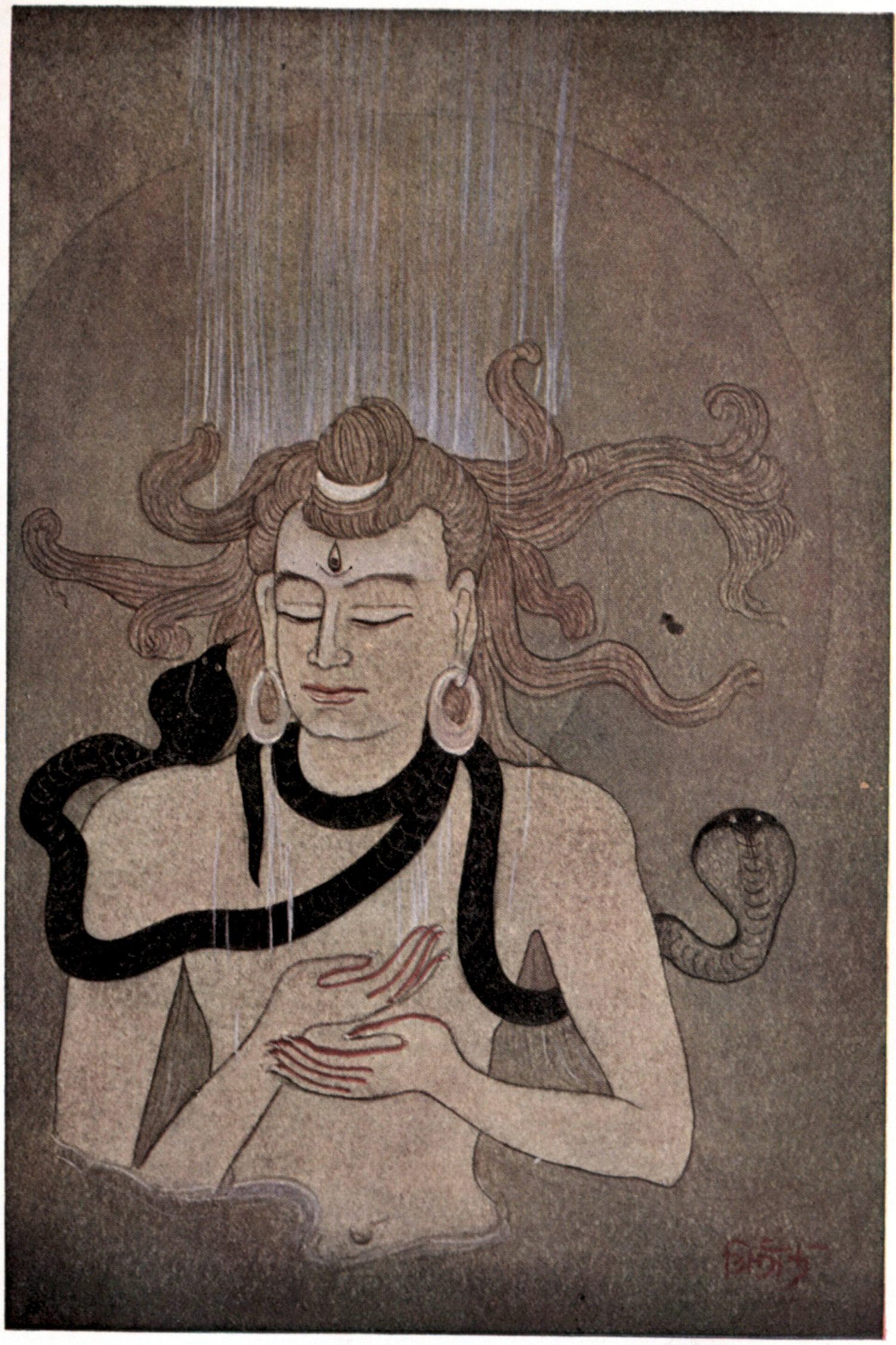
Bhagiratha's prayers bring Ganga to earth to free his ancestors; Shiva breaks her fall in his matted locks.
The Puranic age पुराण काल
The Puranas are vast collections of stories, genealogies, rituals and pilgrim guides. They were composed and reworked over many centuries, so scholars give them ranges, roughly the 4th to the 12th century CE, with later additions still. Most of the familiar stories of Shiva, his marriage, his sons and his forms, take shape here.
The Shiva Purana, Linga Purana and Skanda Purana are central. The Skanda Purana is the largest of all, and its sections praise holy places across India. Pilgrims in Garhwal know the Kedarkhand, a text of the Himalayan tirthas, associated by tradition with the Skanda Purana. Its date and relation to printed Skanda Purana editions are uncertain.
Shiva Purana शिव पुराण
Seven samhitas on creation, Sati and Parvati, the Jyotirlingas, worship and liberation. Its present form gathers material of many periods.
Linga Purana लिंग पुराण
Explains the lingam as the sign of the formless Shiva, tells the pillar-of-fire story and gives rules of Shaiva worship and vows.
Skanda Purana स्कन्द पुराण
Named after Skanda, son of Shiva. Its oldest manuscript is from Nepal; later printed editions add large tirtha-mahatmya sections.
Kedarkhand केदारखंड
A pilgrim text of the Kedar region, its rivers, prayags and shrines, including the places now called the Panch Kedar.
Vayu and Kurma Puranas
Among the older Puranas, with early accounts of Pashupata teaching and of Shiva as the supreme yogi.
Puranic dates are scholarly estimates; each text grew in layers over centuries.
The temple age मंदिर युग
From around the 5th century CE, devotion to Shiva took lasting form in rock and stone. Kings competed to build ever larger shrines, and sculptors gave the stories of the Puranas faces and bodies. Some of the greatest works of Indian art were made for Shiva.
In the south, the Chola period also produced the bronze images still carried in temple festivals, above all Nataraja, the dancing Shiva in a ring of fire.
Elephanta Caves घारापुरी
Rock-cut halls on an island, famous for the great three-headed Sadashiva bust, nearly six metres tall, and panels of Shiva's marriage and Ganga's descent.
Kailasa Temple, Ellora (Cave 16) कैलाश मंदिर
A whole temple carved downward from one basalt hill, made to stand for Mount Kailash. Usually credited to Krishna I (r. c. 756–774).
Brihadeeswarar, Thanjavur बृहदीश्वर
The great Chola temple, its vimana about 66 metres tall. Part of the UNESCO Great Living Chola Temples.
Chola bronzes
Lost-wax bronzes of Nataraja, Somaskanda and Ardhanarishvara, made to be dressed and carried in procession.
Adi Shankaracharya and Kedarnath आदि शंकराचार्य
Adi Shankaracharya, the great teacher of Advaita Vedanta, is usually dated to the 8th century CE, though some place him slightly earlier. He wrote commentaries on the Upanishads, the Gita and the Brahma Sutras, and founded monastic orders that still exist.
Garhwal tradition holds that Shankara revived the worship at Kedarnath and Badrinath, and that he ended his earthly life near Kedarnath at about the age of 32. His samadhi shrine stands behind the temple and was rebuilt after the 2013 flood. These accounts come from hagiographies written centuries after him, so historians treat details with care.
Shankara's dates and the details of his link to Kedarnath come mainly from later tradition.
The living tradition जीवित परंपरा
Today Shiva is worshipped by hundreds of millions of people, in household shrines, village temples and great pilgrim centres. The Vedic Rudram is still chanted, the Puranic stories are still told, and the old schools of Shaiva thought are still taught.
Every year, crowds walk to Kedarnath and the other Panch Kedar shrines when the snow allows. Kanwar pilgrims carry Ganga water to Shiva in the month of Shravan, and Mahashivratri keeps homes awake through the night. The god of the storm has become, for millions, a close and kindly presence.
Sources
- Rig Veda 1.43, 1.114, 2.33, 7.46, 7.59.12 (Jamison and Brereton translation, 2014)
- Taittiriya Samhita 4.5 and 4.7 (Shri Rudram: Namakam and Chamakam)
- Shvetashvatara Upanishad, Olivelle, The Early Upanishads (1998)
- Mahabharata, Vana Parva (Kairata) and Anushasana Parva
- Valmiki Ramayana, Bala Kanda (descent of Ganga)
- Shiva Purana; Linga Purana; Skanda Purana (Adriaensen, Bakker and Isaacson, Skandapurana vol. I, 1998)
- Marshall, Mohenjo-daro and the Indus Civilization (1931); Srinivasan, "The So-Called Proto-Siva Seal from Mohenjo-Daro" (1975)
- Flood, An Introduction to Hinduism (1996)
- Kramrisch, The Presence of Siva (1981)
- Chakravarti, The Concept of Rudra-Siva through the Ages (1986)
- UNESCO World Heritage listings: Elephanta Caves; Ellora Caves; Great Living Chola Temples
- Wikipedia (cross-check): Pashupati seal; Shri Rudram; Kailasa Temple, Ellora; Brihadisvara Temple; Adi Shankara
Traditional accounts are presented as tradition. Dates are approximate ranges used by scholars.