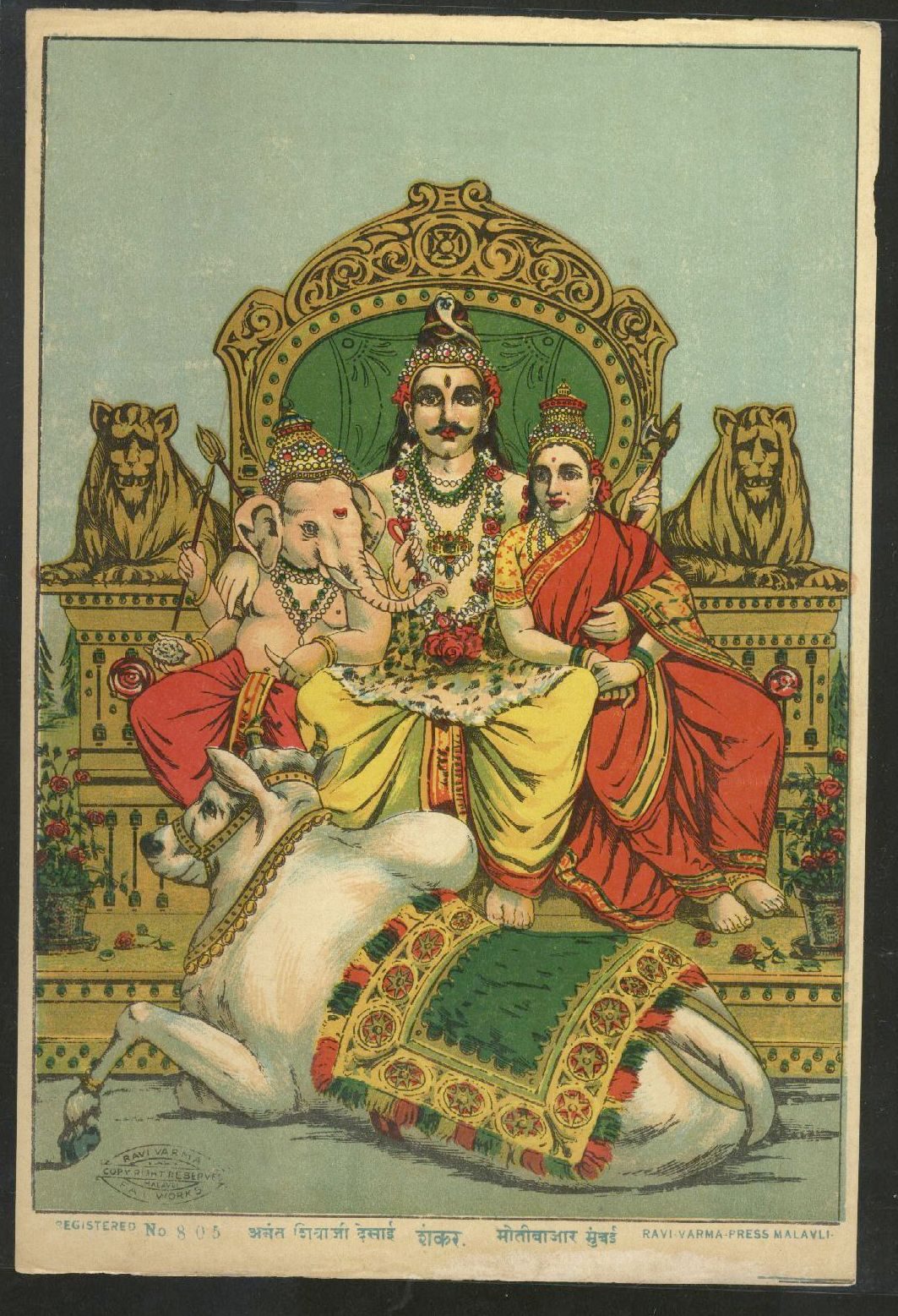
Rudra in the Vedic hymns वैदिक रुद्र सूक्त
The oldest words addressed to Shiva are addressed to Rudra. The Rig Veda, composed in stages between roughly 1500 and 1000 BCE, gives him only a handful of hymns, but they already hold both sides of his nature: the fierce archer of the storm and the healer with a thousand medicines.
Worshippers ask Rudra to keep his anger away from their children and cattle, and in the same breath call him the best physician. The word "shiva", meaning kind or auspicious, appears here as a description of Rudra long before it became his name.
Rig Veda 1.43
A short hymn to Rudra as giver of health to people, horses and cattle, paired with Soma.
Rig Veda 1.114
A prayer for mercy: "harm not our elders, harm not our young". Rudra is called the one with braided hair, kapardin, an early sign of the jata.
Rig Veda 2.33
The fullest Rig Vedic hymn to Rudra. He is father of the Maruts, the storm gods, and holder of healing remedies, praised as mightiest of the mighty.
Rig Veda 7.46
Rudra as the archer with the swift arrow, asked to protect and not to strike.
Rig Veda 7.59.12
The Tryambakam verse, known today as the Mahamrityunjaya mantra. It closes a hymn to the Maruts and is repeated in the Yajur Veda.
Atharva Veda
Rudra appears with Bhava and Sharva, and as Pashupati, lord of creatures. Later Shaiva names begin to gather around him here.
Dates for the Vedas are approximate; scholars give ranges, not years.
Shri Rudram: Namakam and Chamakam श्री रुद्रम्
The Shri Rudram is the great Vedic litany of Shiva, still chanted at abhishek in temples across India. It comes from the Taittiriya Samhita of the Krishna Yajur Veda, a text scholars place around 1000–800 BCE.
It has two parts. The Namakam, Taittiriya Samhita 4.5, salutes Rudra again and again with "namah", seeing him in hunters and thieves, in rivers and paths, in the grass and the dust. The Chamakam, 4.7, repeats "cha me", "and to me", asking for every good thing a life may need.
In the eighth section of the Namakam stand the words "namah shivaya cha shivataraya cha". This is the earliest setting of the Panchakshara phrase.
Namakam नमकम्
Eleven anuvakas of salutation. Rudra is asked to turn his arrows away and to be gentle, and is then found in every corner of the world.
Chamakam चमकम्
Eleven anuvakas of petition, from food and strength to knowledge and long life, ending with the numbers offered in the sacrifice.
Shatarudriya शतरुद्रिय
The parallel version in the Shukla Yajur Veda. Its name means "the hundred Rudras", for the many forms it salutes.
Rudri, Laghurudra, Maharudra
Ritual multiples of the chant. A Rudri is one recitation with abhishek; by common practice a Laghurudra is 121 recitations and a Maharudra 1,331, shared among many priests.
The Shaiva Upanishads शैव उपनिषद्
In the Upanishads, Rudra becomes more than a god of the storm. He becomes the one reality behind the world. The Shvetashvatara Upanishad is the turning point, and several later Upanishads build on it.
Shvetashvatara Upanishad श्वेताश्वतर
The first text to name Rudra-Shiva as the supreme lord who creates, holds and withdraws the worlds. It speaks of grace, and its closing verse praises bhakti, devotion to God and guru.
Atharvashiras Upanishad अथर्वशिरस्
Rudra declares himself to the gods as all that was, is and will be. It is linked with the ash-smeared Pashupata ascetics and their vow.
Kaivalya Upanishad कैवल्य
Brahma teaches that liberation comes through faith, devotion and meditation, not wealth or works. The one meditated on is the three-eyed lord with Uma.
Rudrahridaya and Jabala group
A set of shorter Shaiva Upanishads in the traditional list of 108, including the Rudrakshajabala and Bhasmajabala on rudraksha and sacred ash.
The dating of the Upanishads is uncertain; these ranges follow common scholarly estimates.
The Shaiva Puranas शैव पुराण
The Puranas are long collections of story, cosmology, pilgrimage lore and ritual, composed and revised over many centuries. Most of the stories of Shiva known today, from Sati to the Jyotirlingas, reached their present form in them.
Tradition counts eighteen great Puranas and assigns several to Shiva. Because each was edited for centuries, scholars date layers, not whole books.
Shiva Purana शिव पुराण
The best known Shaiva Purana, a vast work of myth, ritual and devotion. Printed editions have seven samhitas; tradition says there were once twelve.
Linga Purana लिंग पुराण
Centres on the linga: the pillar of light, its worship and its meaning. It also covers cosmology, Pashupata yoga and the thousand names.
Skanda Purana स्कन्द पुराण
The largest Purana, named after Shiva’s son. Its many khandas are pilgrimage guides to sacred places across India, including Kashi and the Himalaya.
Vayu Purana वायु पुराण
Among the oldest Puranas. It treats Shiva as the supreme lord and preserves early teaching on Pashupata yoga.
Kurma Purana कूर्म पुराण
Told by Vishnu as the tortoise, yet strongly Shaiva. It contains the Ishvara Gita, a dialogue in which Shiva teaches yoga and devotion.
Puranic dates are disputed and vary by scholar; treat these as rough ranges.
Inside the Shiva Purana शिव पुराण की संहिताएँ
The printed Shiva Purana has seven samhitas, or books. Together they move from how to worship, to the great stories, to the shrines and finally to teaching.
Vidyeshvara Samhita
How to worship: the linga, the five-syllable mantra, sacred ash and rudraksha. It tells how the pillar of fire humbled Brahma and Vishnu.
Rudra Samhita
The heart of the narrative, in five parts: creation, Sati and Daksha, Parvati’s penance and marriage, the birth of Kartikeya and Ganesha, and Shiva’s battles.
Shatarudra Samhita
The hundred avatars and forms of Shiva, including Bhairava, Virabhadra, Hanuman as Shiva’s portion, and the Kirata who tested Arjuna.
Kotirudra Samhita
The shrines: the twelve Jyotirlingas and their stories, and the thousand names with which Vishnu worshipped Shiva.
Uma Samhita
Stories of the goddess, sin and its fruit, the hells, and the worth of gifts and vows.
Kailasa Samhita
The meaning of Om and the path of the renouncer, taught on Kailash.
Vayaviya Samhita
Shaiva philosophy in two parts: the lord, the bound soul and its bonds, and the ways of release.
Kedarkhand: the Himalaya in the Puranas केदारखण्ड
Garhwal was known of old as Kedarkhand, the land of Kedar. The name belongs to two things. It is the title of the first part of the Maheshvara Khanda of the Skanda Purana, a book of Shiva stories, and it is also the name of a Himalayan mahatmya, a pilgrim’s guide kept in Garhwal, that describes the shrines and rivers of the region.
The regional Kedarkhand lists the sacred places from Haridwar to the snows: Kedarnath, Badrinath, the confluences of the Alaknanda and the holy kunds. Much local lore about the Panch Kedar is drawn from it and from the priestly families who recite it.
Kedara Khanda
The opening section of the Maheshvara Khanda in printed editions, telling of Daksha’s sacrifice, the churning of the ocean and Parvati’s penance.
Kedarkhand mahatmya
The regional pilgrimage text of Garhwal. It praises the Himalayan tirthas and gives their stories and rewards.
Manaskhand
The companion text for Kumaon, the land of the Manas lake, covering the eastern half of Uttarakhand.
How the Garhwal Kedarkhand relates to the printed Skanda Purana is debated; scholars treat it as a later regional mahatmya.
The Shaiva Agamas शैव आगम
Alongside the Vedas runs a second stream of scripture: the Agamas, or Tantras. Shaiva Siddhanta counts twenty-eight, said in tradition to have been taught by Shiva himself. Scholars date the earliest, such as the Nishvasa, to roughly the 5th–6th century CE, with most composed over the following centuries.
The Agamas govern how a temple is built and how Shiva is worshipped in it, from the measures of the sanctum to the daily rites and the yearly festivals. Most South Indian Shiva temples still follow them, the Kamika Agama above all.
Ten Shivabheda Agamas
The first group, beginning with the Kamika, Yogaja, Chintya, Karana and Ajita, and ending with the Suprabheda.
Eighteen Rudrabheda Agamas
The second group, including the Vijaya, Svayambhuva, Raurava, Makuta, Kirana and Vatula.
Four padas
Each Agama, in principle, has four parts: knowledge (jnana), meditation (yoga), ritual (kriya) and conduct (charya).
Temple ritual
The Agamas set the daily pujas, often six a day in large temples, the installation of the linga, purification rites and the annual festival with its flag-hoisting and chariot.
Upagamas and paddhatis
Hundreds of subsidiary texts and priestly manuals, such as the 11th-century Somashambhu Paddhati, turn Agamic rules into working ritual.
In the Himalaya, temples such as Kedarnath follow their own priestly lineages rather than the South Indian Agamic system.
The great Sanskrit stotras शिव ताण्डव और महिम्न स्तोत्र
Stotras are hymns of praise meant to be sung or recited. Two stand at the head of Shaiva devotion. The Shiva Tandava Stotram, in a pounding metre that imitates the drum, is attributed by tradition to Ravana. The Shiva Mahimna Stotra, gentle and philosophical, is attributed to the gandharva Pushpadanta.
The Tandava Stotram paints Shiva dancing with Ganga in his locks and the damaru sounding. The Mahimna Stotra says that even the Vedas cannot tell Shiva’s greatness, and that all paths reach him as all rivers reach the sea.
जटाटवीगलज्जलप्रवाहपावितस्थले गलेऽवलम्ब्य लम्बितां भुजङ्गतुङ्गमालिकाम्। डमड्डमड्डमड्डमन्निनादवड्डमर्वयं चकार चण्डताण्डवं तनोतु नः शिवः शिवम्॥
jaṭāṭavīgalajjalapravāhapāvitasthale gale’valambya lambitāṃ bhujaṅgatuṅgamālikām | ḍamaḍḍamaḍḍamaḍḍamanninādavaḍḍamarvayaṃ cakāra caṇḍatāṇḍavaṃ tanotu naḥ śivaḥ śivam ||
“With his neck made holy by the stream of water flowing from the forest of his matted hair, with a tall garland of serpents hanging from it, and with his drum sounding "damad, damad, damad", he danced the fierce tandava. May that Shiva bring us good.”
Shiva Tandava Stotram, verse 1
Shiva Tandava Stotram शिव ताण्डव स्तोत्रम्
Fifteen to seventeen verses in the panchachamara metre. Tradition says Ravana sang it when Shiva pressed Kailash down upon him. The real author and date are unknown.
Shiva Mahimna Stotra शिव महिम्न स्तोत्र
About forty verses. The story goes that Pushpadanta lost his powers for stealing flowers from a king’s garden that were meant for Shiva, and won them back with this hymn.
The Mahimna Stotra is quoted in an 11th-century inscription, so it is at least that old; its true author is unknown.
Hymns of the temple: Lingashtakam and its kin लिंगाष्टकम्
Some hymns are sung so often at evening aarti that they belong to every Shiva temple. The Lingashtakam, eight verses each ending "I bow to that linga of Sadashiva", is the most familiar. Its author is unknown.
Ashtakams, hymns of eight verses, are easy to learn and to sing together, which is why so many have come down to us.
ब्रह्ममुरारिसुरार्चितलिङ्गं निर्मलभासितशोभितलिङ्गम्। जन्मजदुःखविनाशकलिङ्गं तत्प्रणमामि सदाशिवलिङ्गम्॥
brahmamurārisurārcitaliṅgaṃ nirmalabhāsitaśobhitaliṅgam | janmajaduḥkhavināśakaliṅgaṃ tat praṇamāmi sadāśivaliṅgam ||
“The linga worshipped by Brahma, Vishnu and the gods, the linga shining pure and beautiful, the linga that destroys the sorrow born of birth: to that linga of Sadashiva I bow.”
Lingashtakam, verse 1
Lingashtakam लिंगाष्टकम्
Praises the linga worshipped by Brahma, Vishnu and the gods, smeared with sandal and saffron, destroyer of the sorrow of birth.
Bilvashtakam बिल्वाष्टकम्
Each verse ends by offering a single bel leaf to Shiva. It opens with the three-part leaf as the three gunas and the three eyes.
Shivashtakam शिवाष्टकम्
Beginning "prabhum pranatham vibhum vishvanatham", it praises Shiva as lord of life and of the universe. Tradition often credits it to Shankara.
Shiva Sahasranama शिव सहस्रनाम
The thousand names. The best known version is in the Mahabharata, Anushasana Parva, taught by the sage Tandi through Upamanyu to Krishna. The Shiva Purana gives the names with which Vishnu worshipped Shiva.
Shiva Chalisa शिव चालीसा
Forty Hindi verses, sung in homes across North India, especially on Mondays and in Shravan.
Hymns attributed to Shankara शंकराचार्य के स्तोत्र
Tradition credits Adi Shankara, the 8th-century teacher of Advaita who is said to have reached Kedarnath at the end of his life, with many hymns to Shiva. Scholars accept only some of the hymns credited to him as his own; many were written later in his name.
The Shiva Panchakshara Stotram builds one verse on each syllable of "na-mah-shi-va-ya", so that reciting it becomes a slow meditation on the mantra.
नागेन्द्रहाराय त्रिलोचनाय भस्माङ्गरागाय महेश्वराय। नित्याय शुद्धाय दिगम्बराय तस्मै नकाराय नमः शिवाय॥
nāgendrahārāya trilocanāya bhasmāṅgarāgāya maheśvarāya | nityāya śuddhāya digambarāya tasmai nakārāya namaḥ śivāya ||
“To him who wears the king of serpents as a garland, the three-eyed one, whose body is anointed with ash, the great lord; to the eternal, the pure, the one clothed by the sky: to him, the syllable "na", salutation to Shiva.”
Shiva Panchakshara Stotram, verse 1
Shiva Panchakshara Stotram शिव पंचाक्षर स्तोत्रम्
Five verses and a closing blessing. Each verse ends "tasmai ... karaya namah shivaya", bowing to the syllable it describes.
Shivananda Lahari शिवानन्दलहरी
A hundred verses, "the wave of Shiva’s bliss", full of images of the devotee as a hunter, a monkey or a child.
Dakshinamurti Stotram दक्षिणामूर्ति स्तोत्रम्
Ten verses to Shiva as the silent teacher, condensing Advaita into a hymn.
Shiva Aparadha Kshamapana
A hymn asking Shiva to forgive faults of body, speech and mind committed through each stage of life.
Rudrashtakam and Shiva in the Ramcharitmanas रुद्राष्टकम्
Goswami Tulsidas, who wrote the Ramcharitmanas in Awadhi in the late 16th century, placed Shiva at its heart. The whole story of Rama is told by Shiva to Parvati, and Tulsidas opens with praise of both.
In the Uttar Kand a brahmin sings the Rudrashtakam to calm Shiva’s anger at a disrespectful pupil. Though the Manas is in Awadhi, this hymn is in Sanskrit, and it has become one of the most loved Shiva hymns of North India.
नमामीशमीशान निर्वाणरूपं विभुं व्यापकं ब्रह्मवेदस्वरूपम्। निजं निर्गुणं निर्विकल्पं निरीहं चिदाकाशमाकाशवासं भजेऽहम्॥
namāmīśamīśāna nirvāṇarūpaṃ vibhuṃ vyāpakaṃ brahmavedasvarūpam | nijaṃ nirguṇaṃ nirvikalpaṃ nirīhaṃ cidākāśamākāśavāsaṃ bhaje’ham ||
“I bow to you, O lord, ruler of all, whose form is liberation itself, the all-pervading one, Brahman in the form of the Veda. I worship him who rests in himself, beyond qualities, beyond division, beyond desire, the sky of consciousness who dwells in the sky.”
Ramcharitmanas, Uttar Kand (Rudrashtakam, verse 1)
Rudrashtakam रुद्राष्टकम्
Eight verses in Sanskrit praising Shiva as formless, beyond the three gunas, yet the lord of Kailash with Ganga and the moon.
Shiva as narrator
The Manas is framed as a conversation: Shiva tells the tale of Rama to Parvati, and Kakabhushundi tells it to Garuda.
Shiva–Parvati vivah
Tulsidas tells the marriage of Shiva and Parvati at length, and it is still sung at weddings across the Hindi belt.
The Tamil Tirumurai तिरुमुरै
In the Tamil country, devotion to Shiva found its voice in song. Between roughly the 6th and 9th centuries, the Nayanars, sixty-three saints of every caste, walked from temple to temple singing of the Shiva who lived there.
Their songs were gathered into twelve books, the Tirumurai, which tradition says Nambiyandar Nambi compiled around the 10th–11th century. Odhuvars, temple singers, still sing them daily in Tamil Nadu.
Tevaram तेवारम्
The hymns of Sambandar, Appar and Sundarar, set to traditional melodies. They name over 270 temples, the padal petra sthalams.
Tiruvasagam तिरुवासगम्
The intensely personal songs of Manikkavasagar, a minister who gave up the court for Shiva. A Tamil saying holds that one whose heart does not melt at it will melt at nothing.
Tirukkovaiyar
Manikkavasagar’s love poem in the old Tamil style, read as the soul’s longing for Shiva at Chidambaram.
Tirumantiram तिरुमन्तिरम्
About three thousand verses by the yogi Tirumular on yoga, ethics and Shaiva philosophy. "Anbe Sivam", love is Shiva, is its best-known teaching.
Periya Puranam पेरिय पुराणम्
Sekkizhar’s lives of the sixty-three Nayanars, the twelfth and last book.
Meykandar and Shaiva Siddhanta
Meykandar’s Shivajnanabodham, twelve short sutras, became the root text of Tamil Shaiva Siddhanta philosophy.
The Kannada vachanas कन्नड़ वचन
In 12th-century Karnataka, a movement gathered around Basavanna, a minister at Kalyana. Its members, the Sharanas, wrote short prose poems called vachanas, "things said", in plain Kannada. They rejected caste and empty ritual, and spoke straight to Shiva as Lord of the Meeting Rivers or Jasmine-white Lord.
Each poet signed with their own name for Shiva. Their tradition is today the Lingayat or Virashaiva community, whose members wear a small linga on the body.
Basavanna बसवण्णा
Leader of the movement. His vachanas say the body is the temple: "the rich will make temples for Shiva; what shall I, a poor man, do?"
Akka Mahadevi अक्का महादेवी
A young woman who left home for Shiva and wandered as an ascetic. Her poems burn with longing for her divine lover.
Allama Prabhu अल्लमप्रभु
The mystic of the movement, whose riddling vachanas push past every form towards emptiness.
Anubhava Mantapa
Tradition holds that the Sharanas met in this "hall of experience" at Kalyana to discuss their faith, men and women alike.
The Shiva Sutras of Kashmir शिव सूत्र
In Kashmir, from about the 9th century, a line of teachers built one of India’s most subtle philosophies on Shiva. Its root is the Shiva Sutras, which tradition says Vasugupta found carved on a rock on Mahadev mountain after a dream.
The school teaches that the world is the free self-expression of Shiva as pure consciousness, and that liberation is recognising that one’s own awareness is Shiva.
Shiva Sutras शिव सूत्र
Seventy-seven short aphorisms in three parts, opening "chaitanyam atma": consciousness is the self.
Spanda Karika
Verses on spanda, the subtle vibration of consciousness, ascribed to Vasugupta or his pupil Kallata.
Pratyabhijna
The philosophy of recognition, set out by Utpaladeva in verse.
Abhinavagupta अभिनवगुप्त
The great synthesiser, whose Tantraloka gathers the whole tradition. He also shaped Indian aesthetics.
Kshemaraja
Abhinavagupta’s pupil, whose Pratyabhijnahridayam is a short, much-read primer.
Sources
- Rig Veda 1.43, 1.114, 2.33, 7.46, 7.59.12 (hymns to Rudra)
- Taittiriya Samhita 4.5 and 4.7 (Shri Rudram, Namakam and Chamakam); Vajasaneyi Samhita 16
- Shvetashvatara, Atharvashiras and Kaivalya Upanishads
- Shiva Purana (Vidyeshvara, Rudra, Shatarudra, Kotirudra, Uma, Kailasa, Vayaviya Samhitas)
- Linga, Skanda (Maheshvara Khanda), Vayu and Kurma Puranas
- Mahabharata, Anushasana Parva 13.17 (Shiva Sahasranama)
- Tulsidas, Ramcharitmanas, Bal Kand and Uttar Kand
- Flood, An Introduction to Hinduism (1996)
- Rocher, The Puranas (1986)
- Davis, Ritual in an Oscillating Universe: Worshiping Siva in Medieval India (1991)
- Peterson, Poems to Siva: The Hymns of the Tamil Saints (1989)
- Ramanujan, Speaking of Siva (1973)
- Dyczkowski, The Doctrine of Vibration (1987); Singh, Siva Sutras (1979)
- Sanderson, "Saivism and the Tantric Traditions" (1988)
Traditional accounts are presented as tradition. Dates are approximate ranges used by scholars.