The linga: a sign of the formless लिंग
Linga means a mark or sign, the thing by which something is known. For Shaivas it is the sign of a god who has no form of his own. The Shiva Purana says Shiva is worshipped in two ways, as a figure with a body (sakala) and as the linga (nishkala), and that the linga is the higher of the two because it points beyond shape.
A full linga has three parts. The square base is called the Brahma-bhaga, the eight-sided middle the Vishnu-bhaga, and the rounded top the Rudra-bhaga or puja-bhaga. Only the top is seen above the pedestal and receives the offerings.
The pedestal, called the pitha or yoni-pitha, is the seat of Shakti. Tradition reads the linga standing in it as Shiva and Shakti together: pure awareness held within creative power, the unmoving within the moving. Neither is complete alone. The pitha also has a practical task. Its spout carries the abhishek water away to the north.
Historians find worshipped lingas early. The Gudimallam linga in Andhra Pradesh, carved with a standing figure of Shiva, is usually dated to roughly the 2nd to 1st century BCE. Faces were added to lingas in the Kushana and Gupta periods, giving the mukhalinga.
Jyotirlinga ज्योतिर्लिंग
A linga of light. Tradition holds that at twelve places Shiva appeared as the endless pillar of fire that Brahma and Vishnu could not measure, and stayed as a linga. The Shiva Purana closes its Shatarudra Samhita with these twelve.
Swayambhu linga स्वयम्भू लिंग
A self-manifest linga, not carved or installed by anyone. It may be a natural rock, a spring or a pillar of ice. The rough triangular rock at Kedarnath, read as the hump of the bull, is worshipped as swayambhu.
Banalinga बाणलिंग
Smooth egg-shaped stones from the bed of the Narmada, polished by the river and often streaked with natural marks. They are worshipped without any rite of installation, because the river is said to have made them already holy. Tradition links the name with Bana, a devotee of Shiva.
Mukhalinga मुखलिंग
A linga carved with one, four or five faces. The single-faced lingas of the Gupta period, and the four-faced ones that look to the four directions, show the formless sign beginning to take a face.
Parthiva linga पार्थिव लिंग
A linga shaped by hand from clay or river earth for one day’s worship and then given back to water. It is the humblest linga and, in the Shiva Purana, among the most praised, because anyone can make one.
Pancha Bhuta lingas पंचभूत लिंग
Five South Indian temples where the linga is worshipped as one of the five elements: earth at Kanchipuram, water at Thiruvanaikaval, fire at Tiruvannamalai, air at Srikalahasti and space at Chidambaram.
Sphatika and metal lingas स्फटिक लिंग
Small lingas of rock crystal, mercury alloy (parada), gold or silver are kept for home shrines. Texts list many materials and the merit of each, but agree that the devotion matters more than the stone.
Some modern scholars read early lingas such as Gudimallam as phallic in form; Shaiva tradition reads the linga as a sign of the formless. Both readings are found in the literature.
Sadashiva: five faces, five acts सदाशिव और पंचमुख
In Shaiva theology Shiva performs five acts, the panchakritya: creation (srishti), preservation (sthiti), dissolution (samhara), concealment (tirobhava) and grace (anugraha). Concealment is the veiling that lets souls live in the world; grace is the release that sets them free. Brahma and Vishnu do the first two; for the devotee, Shiva does all five.
Sadashiva, the eternal Shiva, is shown with five faces, one for each act. Four look to the directions and the fifth looks upward, often not carved because it is beyond sight. The five Brahma mantras that name these faces are found in the Taittiriya Aranyaka.
The great three-headed figure in the Elephanta cave near Mumbai, carved around the 6th century, is usually read as Sadashiva or Maheshamurti, with the calm, the fierce and the gentle faces side by side.
Ishana ईशान
The upward face, the ruler. It stands for space and for grace, the act that frees the soul. It is seldom shown, because it faces what cannot be seen.
Tatpurusha तत्पुरुष
The face of the supreme person, turned east. It stands for air and for concealment, the veiling by which the one appears as many.
Aghora अघोर
The fierce face, turned south, with fangs and a dark complexion. Aghora means not terrible, a reminder that his fierceness protects. It stands for fire and for dissolution.
Vamadeva वामदेव
The gentle, beautiful face, turned north, sometimes shown with feminine features. It stands for water and for preservation.
Sadyojata सद्योजात
The face that is born at once, turned west. It stands for earth and for creation, the first of the five acts.
This pairing of faces, directions, elements and acts follows Shaiva Siddhanta usage; some texts assign directions or elements differently.
The gentle forms (saumya murti) सौम्य स्वरूप
Temple images of Shiva fall broadly into gentle forms and fierce forms. The gentle forms show him as husband, father, teacher and musician. They fill the bronze halls of South Indian temples, where many are carried out in procession at festivals.
Somaskanda सोमास्कन्द
Shiva seated with Uma and the child Skanda between them: sa-Uma-Skanda, with Uma and Skanda. The family image was a favourite of the Pallava kings, who carved it behind the linga in their temples, and of later Chola bronze-casters.
Kalyanasundara कल्याणसुन्दर
The beautiful bridegroom. Shiva takes Parvati’s hand in marriage, often with Vishnu pouring the water of gift and Brahma as priest. Garhwal holds that the wedding fire still burns at Triyuginarayan.
Uma-Maheshvara उमा-महेश्वर
Shiva seated with Parvati on his left knee, his arm around her. It is a common image in North Indian stone sculpture from the Gupta period on, including the temples of Uttarakhand.
Dakshinamurti दक्षिणामूर्ति
The teacher who faces south, seated under a banyan tree with sages at his feet. He teaches in silence, his hand in chin-mudra. South Indian temples place him in a niche on the south wall.
Ardhanarishvara अर्धनारीश्वर
Right half Shiva, left half Parvati, with one breast, one earring of each kind, and half the hair in jata. The Shiva Purana tells that Shiva took this form so that Brahma could learn that creation needs both.
Harihara हरिहर
Right half Shiva, left half Vishnu, with matted hair on one side and a crown on the other. The form says the two great gods are one. Early examples are carved in the cave temples of Badami.
Vinadhara वीणाधर
Shiva as master of music, holding the vina. Some bronzes show the hands posed for an instrument that is no longer there. He is the lord of sound as well as of silence.
Bhikshatana भिक्षाटन
The naked, beautiful beggar who wandered into the pine forest (Daruvana), where the sages’ wives followed him in a trance. He carries a skull bowl and is followed by a deer. The story tests the sages’ pride in ritual.
The fierce forms (ugra murti) उग्र स्वरूप
The fierce forms show Shiva destroying what threatens the order of the worlds: pride, lust, death itself. In each story the enemy is in some way the ego. Tamil tradition keeps eight temples, the Ashta Virattanam, each remembering one of these victories.
Bhairava भैरव
Born from Shiva’s wrath when Brahma’s fifth head spoke in pride. Bhairava cut it off, and the skull stuck to his hand. He wandered as a penitent until it fell away at Kapalamochana in Kashi. He has dogs, a skull and a fierce face.
Kala Bhairava of Kashi काल भैरव
Tradition makes Kala Bhairava the kotwal, the guardian-magistrate of Kashi, who decides who may stay in the city. Pilgrims visit his temple in Varanasi to take leave. Kedarnath has its own Bhairavnath, who guards the shrine in winter.
Virabhadra वीरभद्र
The warrior born from a lock of Shiva’s hair, torn out in grief and anger at Sati’s death. He destroyed Daksha’s sacrifice. He is much worshipped in Karnataka and Andhra Pradesh, as at Lepakshi.
Sharabha शरभ
A being part lion, part bird and part man. The Shiva Purana tells that Shiva took this form to calm Narasimha, whose fury did not end after he killed Hiranyakashipu. A fine Chola relief survives at Tribhuvanam.
Aghoramurti अघोरमूर्ति
The fierce form from the southern face, worshipped above all at Tiruvenkadu, where tradition says he subdued the demon Maruthuvasura. He is shown many-armed, dark, with weapons.
Kalantaka कालान्तक
The ender of death. Shiva burst from the linga to strike Yama, who had thrown his noose over the boy Markandeya. Images show Yama fallen under Shiva’s foot.
Gajasurasamhara गजासुरसंहार
Shiva killed an elephant demon and danced inside its flayed hide, holding it up behind him like an arch. This is why he is called Krittivasa, clothed in a hide. Kashi has a Krittivasheshvara linga.
Andhakasuravadha अन्धकासुरवध
Shiva spears the blind demon Andhaka, who desired Parvati, and holds him aloft on the trident. Each drop of Andhaka’s blood bred a new demon until it was caught. Ellora and Elephanta have powerful carvings of it.
Tripurantaka त्रिपुरान्तक
The archer who burned the three flying cities with one arrow. In bronze he stands with a bent bow (Pinaka) in his hands, though the bow itself is often lost; Parvati as Tripurasundari may stand beside him.
Kamantaka कामान्तक
The burner of desire. When Kama shot his flower-arrow, the third eye opened and turned him to ash. The form honours the yogi who cannot be moved by craving.
The Sharabha story is a Shaiva telling; some Vaishnava texts answer it with Narasimha taking the still fiercer Gandabherunda form.
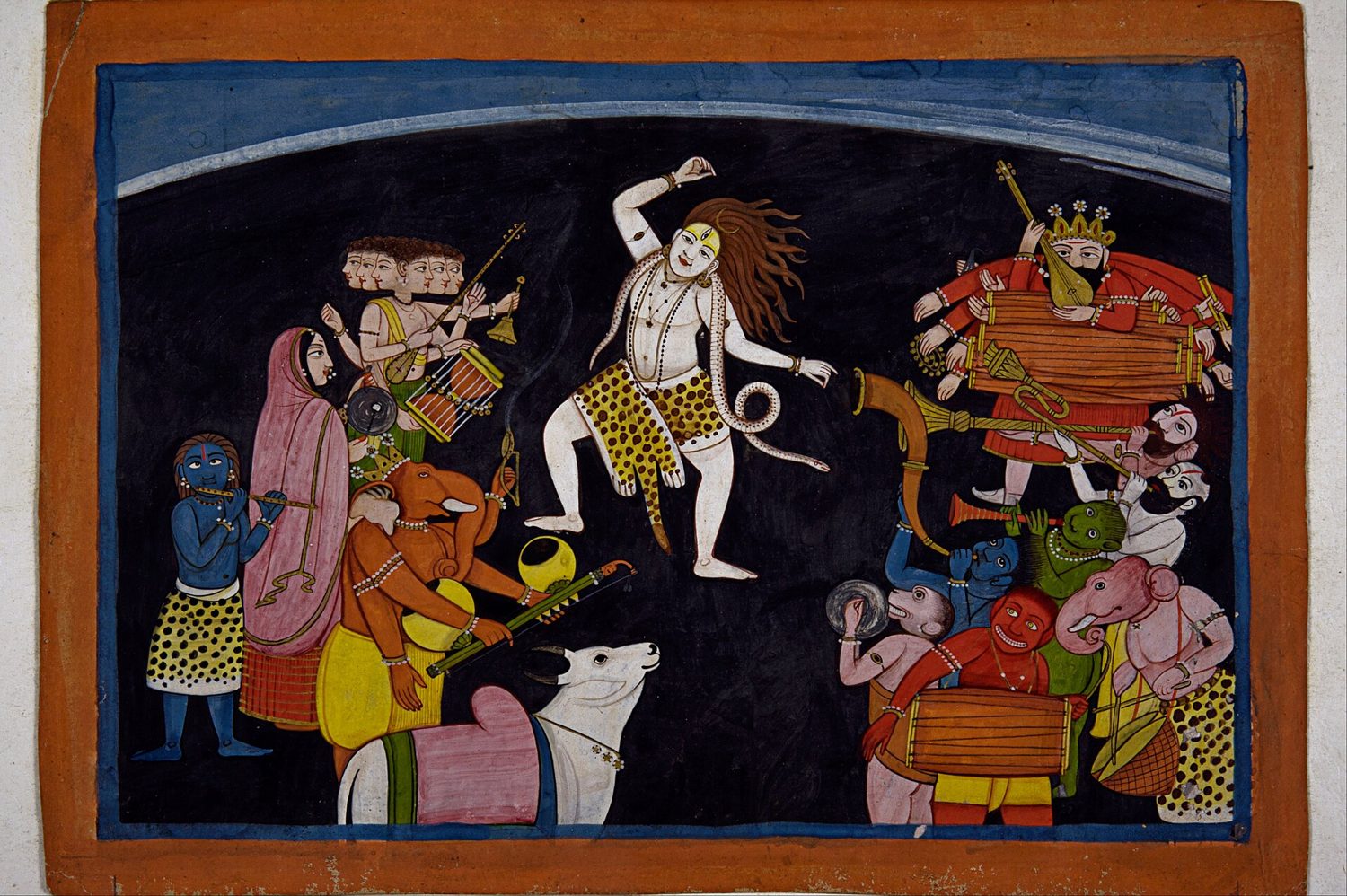
Nataraja and the 108 karanas नटराज और करण
Chidambaram in Tamil Nadu is the temple of Nataraja, the king of dance. Tradition holds that Shiva danced the ananda tandava, the dance of bliss, there for the sages Patanjali and Vyaghrapada. He is worshipped in the golden hall (Kanaka Sabha) both as the bronze dancer and as space itself, the akasha linga.
Behind a curtain beside the image is the Chidambara Rahasya, the secret of Chidambaram: an empty space hung with a garland of golden bilva leaves. It says the god is present where there is nothing to see.
The Natyashastra, the old treatise on drama, describes 108 karanas, units of movement in the tandava. Sculptors carved them on the gopurams of Chidambaram, probably around the 12th to 13th century, each panel labelled with its verse. Dancers still use them to reconstruct the old technique.
Shaiva texts also distinguish the fierce rudra tandava, danced at the end of an age, from the gentle lasya of Parvati. Chidambaram’s great festivals are Arudra Darshanam in Margazhi and the Ani Thirumanjanam in summer.
Ananda tandava आनंद तांडव
The dance of bliss, the pose of the Chola bronzes. All five acts are in it: the drum creates, the raised hand protects, the fire dissolves, the planted foot conceals and the lifted foot gives grace.
Rudra tandava रुद्र तांडव
The dance of destruction at the end of a cycle, and the dance of grief after Sati’s death. It is shown with many arms and a wild movement.
The karana panels करण
Small reliefs of a dancer in each of the 108 positions, with the Natyashastra verse carved below. Chidambaram, the Brihadishvara temple at Thanjavur and the Sarangapani temple at Kumbakonam have such series.
Pancha Sabhai पंच सभा
Five halls where Tamil tradition says Shiva danced: gold at Chidambaram, silver at Madurai, copper at Tirunelveli, jewel at Thiruvalangadu and picture at Courtallam.
The nineteen avatars of the Shiva Purana शिव के उन्नीस अवतार
The Shatarudra Samhita, the third section of the Shiva Purana, is a book of Shiva’s incarnations. Its fifth chapter promises nineteen, and the following chapters tell them one by one. The list below is the nineteen most often given in Hindi and English retellings, with the chapter where each is told.
Unlike Vishnu, Shiva is not said to be born in a womb in the usual way. Most of these are appearances: a disguise to test a devotee, a son granted to a sage, a portion of his power working through another being.
Pippalada पिप्पलाद
Son of the sage Dadhichi, who gave his bones for Indra’s thunderbolt. Learning that Shani had troubled his father, he struck Shani down, and let him go only on a promise to spare young children. He is worshipped for relief from Shani.
Nandishvara नन्दीश्वर
The childless sage Shilada did penance and received a son, Nandi. Told he would die young, Nandi worshipped Shiva and was made immortal, chief of the ganas and his door-keeper.
Virabhadra वीरभद्र
Born from Shiva’s matted lock to destroy Daksha’s sacrifice. The Shatarudra Samhita counts him, but tells his story fully in the Rudra Samhita.
Bhairava भैरव
The fierce form who cut off Brahma’s proud fifth head and was freed from the skull at Kashi.
Ashvatthama अश्वत्थामा
The son of Drona, born after Drona’s penance to Shiva. The Shiva Purana calls him a portion of Rudra; the Mahabharata also names him a part of Mahadeva.
Sharabha शरभ
The lion-bird who calmed Narasimha’s fury after the death of Hiranyakashipu.
Grihapati गृहपति
Son of the brahmin Vishvanara and Shuchishmati, born after their prayers at Kashi. Fated to die by fire or lightning, he worshipped Shiva, faced down Indra’s thunderbolt and became lord of fire. His linga at Kashi is Agnishvara.
Durvasa दुर्वासा
The quick-tempered sage, son of Atri and Anasuya. The three gods each granted Anasuya a son: Chandra from Brahma, Dattatreya from Vishnu and Durvasa from Shiva.
Hanuman हनुमान
The Shiva Purana tells that Shiva’s power was carried by the seven sages and placed in Anjana through her ear, so that Hanuman was born to serve Rama.
Vrishabha वृषभ
After the churning of the ocean, sons of Vishnu born in the underworld began to harass the worlds. Shiva took the form of a great bull and destroyed them.
Yatinatha यतिनाथ
Shiva came as an ascetic to the hut of Ahuka, a forest-dwelling tribal, and his wife. The husband slept outside to give the guest shelter and was killed by beasts. Shiva blessed the couple to be reborn as Nala and Damayanti, and came again as a swan (hamsa) to unite them.
Krishnadarshana कृष्णदर्शन
A dark figure who appeared at a sacrifice to claim the leftover wealth. Prince Nabhaga, told by his father that it was Shiva’s due, gave it up honestly and received knowledge in return.
Avadhuteshvara अवधूतेश्वर
A naked wandering ascetic who blocked Indra’s path to Kailash and would not answer him. Indra raised his thunderbolt; Brihaspati recognised Shiva and begged for mercy. The fire of Shiva’s anger was cast into the sea and became Jalandhara.
Bhikshuvarya भिक्षुवर्य
A holy beggar who appeared to a poor brahmin woman and told her to raise an orphaned prince as her own. The boy later regained his kingdom.
Sureshvara सुरेश्वर
Shiva came disguised as Indra to test the boy Upamanyu, offering boons if he would leave Shiva. Upamanyu refused, and Shiva gave him an ocean of milk and lasting devotion.
Brahmachari (Jatila) ब्रह्मचारी
A young matted-haired student who came to Parvati during her penance and spoke ill of Shiva to test her. When she would not listen and turned to leave, he showed himself.
Sunartaka सुनर्तक नट
A dancer who performed in the court of Himavat and asked for Parvati’s hand as his reward.
Yaksheshvara यक्षेश्वर
After the churning, the gods grew proud. A mysterious yaksha set down a blade of grass that Agni could not burn and Vayu could not move. The story echoes the Kena Upanishad.
Kirata किरात
A hunter who quarrelled with Arjuna over a boar both had shot, and then fought him. Pleased with Arjuna’s courage, Shiva revealed himself and gave him the Pashupata weapon. The Mahabharata and Bharavi’s Kiratarjuniya tell it too.
Popular lists of the nineteen vary. The chapters of the Shatarudra Samhita also tell of Mahesha (21), Vaishyanatha (26), Dvijeshvara (27) and a saintly brahmin, Dvija (35), whom some lists include in place of Virabhadra, Sunartaka or Avadhuteshvara.
Other incarnations in the same book अन्य अवतार
The Shatarudra Samhita also gathers Shiva’s forms into groups: five incarnations of the supreme (the five faces), eight forms, ten incarnations paired with ten forms of the goddess, eleven Rudras, and the twelve jyotirlingas. These overlapping counts are why no single number of avatars is final.
Mahesha महेश
Shiva and Parvati appear on earth as Mahesha and Sharada, in a story where a door-keeper of Kailash is cursed to be born as a human.
Vaishyanatha वैश्यनाथ
Shiva comes as a merchant to test the devotion of Mahananda, a woman who worshipped him with great faith, and grants her release.
Dvijeshvara द्विजेश्वर
Shiva and Parvati come as a brahmin couple to test the generosity of King Bhadrayu and his queen.
Sadhu Dvija साधु द्विज
A brahmin visitor to Himavat’s house during the talk of Parvati’s marriage.
The eleven Rudras एकादश रुद्र
Eleven forms born, in this telling, to Kashyapa and Surabhi to protect the gods. Their names vary between texts; Kapali, Pingala, Bhima and Virupaksha are among them.
Ten incarnations दश अवतार
Ten forms of Shiva paired with ten forms of the goddess, such as Mahakala with Mahakali and Tara with Tara. The pairing is close to the Shakta list of the ten Mahavidyas.
Summaries of these less-told chapters are brief; details differ between printed editions.
The Ashta-murti: eight forms in the world अष्टमूर्ति
The eight forms say Shiva is present in everything we live among: the five elements, the sun, the moon, and the person who offers worship. The idea is old. The Shatapatha Brahmana gives eight names of Agni-Rudra, and Kalidasa opens his play Abhijnanashakuntalam with a blessing on the god of the eight visible forms.
The second chapter of the Shatarudra Samhita lists them as below.
Sharva शर्व
Shiva as the earth, which holds all beings.
Bhava भव
Shiva as water, which gives life.
Rudra रुद्र
Shiva as fire, which burns within and without.
Ugra उग्र
Shiva as wind, the fierce one that moves all things.
Bhima भीम
Shiva as space, the vast one that holds the rest.
Pashupati पशुपति
Shiva as the soul of the sacrificer, the lord of all bound beings.
Ishana ईशान
Shiva as the sun, which rules the day.
Mahadeva महादेव
Shiva as the moon, the cooling light.
Texts differ on which name goes with which element, and on the order of the eight.
Sources
- Shiva Purana, Vidyeshvara Samhita (linga worship) and Shatarudra Samhita, chapters 1–42 (incarnations, eight forms, jyotirlingas); English tr. J. L. Shastri (Motilal Banarsidass, 1950s–70s)
- Linga Purana
- Taittiriya Aranyaka (Mahanarayana Upanishad), the five Brahma mantras
- Shatapatha Brahmana 6.1.3 (eight names of Agni-Rudra)
- Kalidasa, Abhijnanashakuntalam, opening benediction
- Natyashastra of Bharata, chapter 4 (108 karanas)
- T. A. Gopinatha Rao, Elements of Hindu Iconography, vol. 2 (1916)
- Stella Kramrisch, The Presence of Siva (1981)
- Wendy Doniger O’Flaherty, Asceticism and Eroticism in the Mythology of Siva (1973)
- Gavin Flood, An Introduction to Hinduism (1996)
- Wisdom Library, Shiva Purana English translation: Shatarudra Samhita chapter list
Traditional accounts are presented as tradition. Dates are approximate ranges used by scholars.