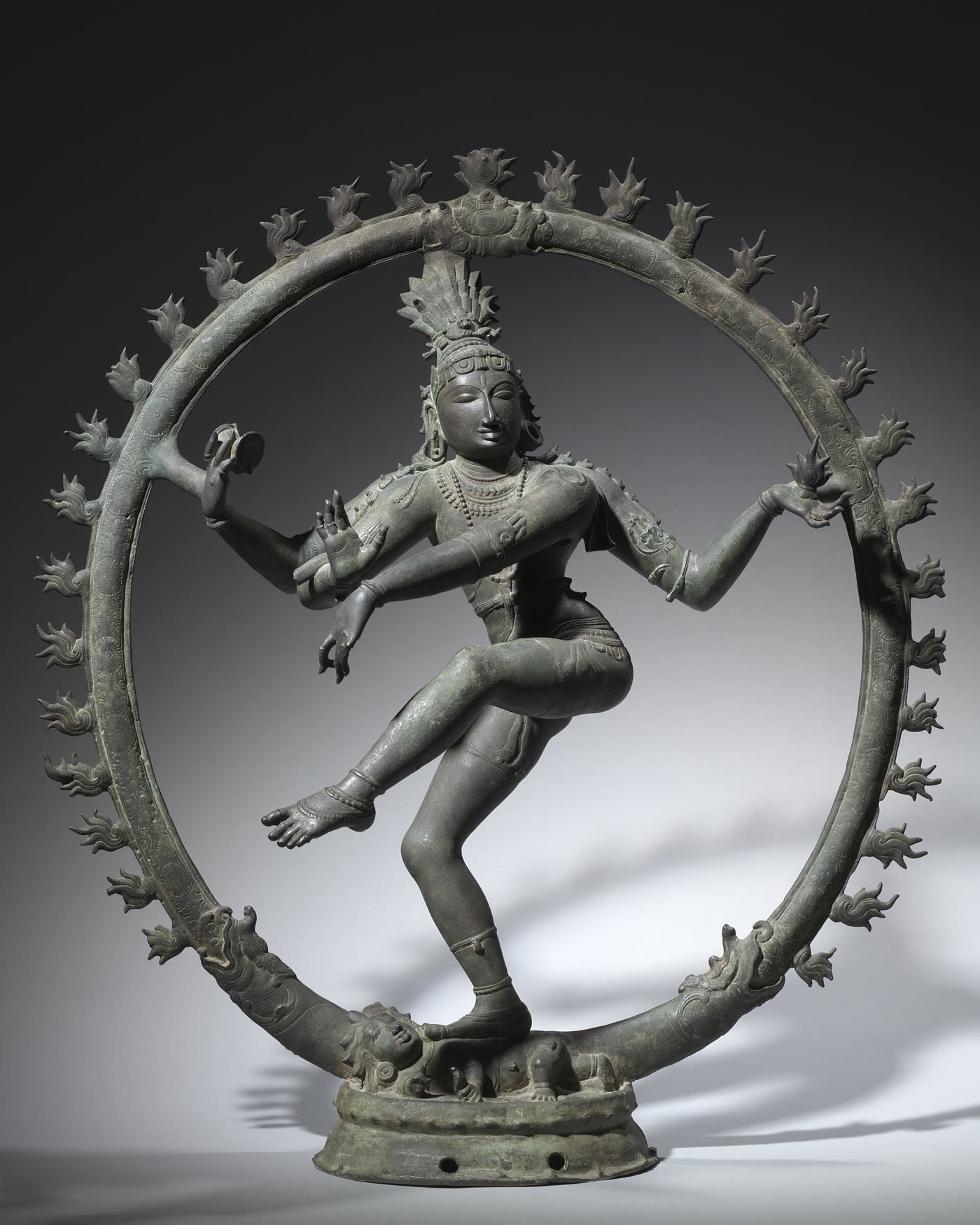
The body शरीर
Sculptors worked from manuals called shilpa shastras and agamas, which give the measurements and marks of each form. The marks below appear on almost every image of Shiva, whether gentle or fierce. Their meanings are the readings of tradition; artists and commentators sometimes give more than one.
Third eye तृतीय नेत्र
An upright eye in the middle of the forehead. Tryambaka, three-eyed, is one of his oldest names. Tradition reads the three eyes as sun, moon and fire, and the third as the sight that burns illusion, as it burned Kama.
Blue throat नीलकंठ
A band of blue or dark colour on the throat, from the halahala poison he held there. In painting it is easy to see; in stone and bronze it is usually left to the viewer to remember.
Ash भस्म
The body smeared with ash, often painted white or grey. Three horizontal lines on the forehead and arms, the tripundra, are worn by his devotees too. Ash is what remains when everything else has burned.
Matted hair जटा
Long matted locks piled into a tall crown (jatamukuta) or flying loose in the dance. The Rig Veda already calls Rudra kapardin, the one with braided hair. Matted hair marks the ascetic who has left the world.
Crescent moon चन्द्रकला
A thin crescent set on the right side of the crown. It gives him the name Chandrashekhara and links him with time, the waxing and waning of the month.
Ganga गंगा
A tiny figure in the hair, often with joined hands and, in Chola bronzes, a fish-like lower body. It shows the river he caught as she fell from heaven.
Serpents नाग
Snakes coil around the neck, arms and waist, or hang as a sacred thread. The one at his neck is named as Vasuki. They show a lord whom poison and death cannot harm.
Two different earrings कुण्डल
Look closely at South Indian images: one ear often has a heavy male earring with a makara or lion face, the other a rolled leaf-shaped earring worn by women. Tradition reads this as Parvati always present in him, the idea of Ardhanarishvara.
Garments वस्त्र
Shiva wears the skins of animals, the clothes of hunters and forest ascetics, not the silks of kings. Each has its own story.
Tiger skin व्याघ्रचर्म
Worn around the waist, often with the head and paws visible. In one telling, the sages of the pine forest sent a tiger against the wandering beggar Shiva, who flayed it and wore its skin.
Elephant hide गजचर्म
Held up behind him like a cloak or arch, from the elephant demon he killed. Hence the name Krittivasa.
Deer skin मृगचर्म
The black antelope skin worn by students and ascetics, sometimes over the left shoulder. It marks Shiva as the great yogi and as the teacher Dakshinamurti.
Sky-clad दिगम्बर
In some forms, such as Bhikshatana and certain Bhairavas, he wears nothing at all: Digambara, clothed by the directions. It shows a god with nothing to hide and nothing to lose.
What he holds आयुध और चिह्न
Images of Shiva usually have four arms, sometimes many more. The back hands hold attributes and weapons; the front hands make gestures. Knowing the objects helps you name the form.
Trishula त्रिशूल
The trident, his chief weapon. In fierce forms it may carry a demon, as with Andhaka. Its three points are read as the three gunas or the three times.
Damaru डमरू
The small two-headed drum, usually in the upper right hand of Nataraja. It keeps the rhythm of creation.
Pinaka पिनाक
His great bow, which gives him the name Pinakin. It is held in Tripurantaka and Kirata images. In the Ramayana it is Shiva’s bow that Rama breaks to win Sita.
Parashu परशु
The battle-axe, often held up in a back hand, especially in South Indian bronzes. Shiva is said to have given an axe to his devotee Parashurama.
Mriga मृग
A small deer leaping on the fingertips of a back hand. Tradition links it with the pine forest story, and reads it as the restless mind brought under control.
Kapala कपाल
A skull used as a begging bowl. It belongs to Bhairava and Bhikshatana and recalls the skull of Brahma that clung to Shiva’s hand.
Khatvanga खट्वांग
A staff topped with a skull, carried by fierce forms and by the Kapalika ascetics who imitated Bhairava.
Akshamala अक्षमाला
A rosary, usually of rudraksha. It shows Shiva as the yogi and teacher, counting the names of the divine.
Pasha पाश
A noose. In Shaiva thought the soul (pashu) is bound by fetters (pasha) and freed by the lord (pati). The noose in his hand says he both binds and releases.
Hand gestures (mudras) मुद्राएँ
The front hands speak to the worshipper. The same gestures are used in classical dance, so a dancer can read a bronze like a sentence.
Abhaya अभय
Right hand raised, palm facing out: do not fear. It is the most common gesture of a protecting god.
Varada वरद
Hand lowered, palm out, fingers pointing down: the giving of boons.
Gaja-hasta गजहस्त
The arm thrown across the body like an elephant’s trunk, as in Nataraja. It points to the raised foot, the refuge of the devotee.
Chin-mudra चिन्मुद्रा
Thumb and forefinger touching in a circle, other three fingers straight. Dakshinamurti teaches with it: the self (forefinger) leaving the three bonds and joining the supreme (thumb).
Kataka कटक
Fingers curled as if to hold a flower. Parvati often makes it beside Shiva, and some bronzes once held a real flower here.
Seats and mounts आसन और वाहन
Where Shiva sits tells you which side of him you are seeing: the householder on the mountain, the yogi on his skin mat, or the lord of the burning ground.
Nandi नन्दी
The bull, his mount and the emblem on his banner. In family images Shiva and Parvati ride Nandi together; in temples Nandi sits facing the sanctum.
Kailash कैलाश
The mountain throne, shown as a heap of rocks, sometimes with Ravana shaking it from below, as in the great relief at Ellora.
Cremation ground श्मशान
Fierce forms are set among pyres, jackals and skulls. Shiva lives where the world ends, so there is no place he does not reach.
Tiger-skin asana व्याघ्रासन
The yogi seated on a tiger skin, legs crossed, eyes half closed. This is the Shiva of Himalayan calendar art.
Banyan tree वटवृक्ष
Dakshinamurti sits under a banyan, with one foot on the dwarf Apasmara and sages, deer and serpents around him.
Colours and materials रंग और सामग्री
Texts describe Shiva as white like camphor or snow, from the ash, with a blue throat and tawny matted hair. Painters follow this; stone and bronze carry the same signs in form instead of colour.
Chola bronze चोल कांस्य
Cast in the lost-wax method in the Kaveri delta, mostly between the 10th and 12th centuries. Each image was modelled in wax, coated in clay and cast once. Holes at the base took poles for carrying in procession. Swamimalai still casts this way.
Katyuri stone कत्यूरी शिल्प
The Katyuri and later rulers of Uttarakhand built temple groups in grey stone, such as Jageshwar and Baijnath, with Shiva, Uma-Maheshvara and Lakulisha images. Historians place much of this work roughly between the 8th and 12th centuries.
Kedarnath stone केदारनाथ
Kedarnath temple is built of large grey stone slabs fitted closely together, on a raised platform. Inside, the linga is a natural rock, not a carved form. Tradition credits the Pandavas and Adi Shankaracharya; historians date the present structure variously.
Pahari painting पहाड़ी चित्रकला
Miniatures of the hill courts, from Basohli and Guler to Kangra and Garhwal, often show Shiva’s family at rest on Kailash. The Garhwal school, linked with the painter Mola Ram of Srinagar (Garhwal), flourished in the late 18th century.
Panchaloha पंचलोह
An alloy of five metals, traditionally including gold, silver and copper, used for festival images. The exact mix is set by tradition and varies by workshop.
The date of the Kedarnath temple is debated; claims of a specific century should be treated with caution.
How to read a Shiva temple शिव मंदिर कैसे देखें
Most Shiva temples follow one order. You move from the outside world, past guardians and the bull, into a small dark chamber where the linga stands. Texts compare the temple to a body, with the sanctum as its heart.
Garbhagriha गर्भगृह
The womb chamber: small, dark, often square, with the linga in the centre. The tower (shikhara) rises directly over it. Only priests usually enter, though at Kedarnath pilgrims may touch the rock.
Nandi mandapa नन्दी मण्डप
A pavilion in front of the sanctum where Nandi sits looking in. Devotees often stand behind or beside him and look at the linga between his horns.
Gomukha or pranala गोमुख
The spout that carries the abhishek water out of the sanctum, often carved as a cow’s or makara’s mouth on the north wall. You do not step over this channel, which is why the circuit is only half.
Chandesha shrine चण्डेश
In South Indian temples, a small shrine near the spout for Chandesha, steward of Shiva’s property. Devotees clap softly or snap fingers before him to show they take nothing from the temple.
Dvarapalas द्वारपाल
Guardian figures at the doorway, often with clubs and one finger raised in warning. Above the door there may be a kirtimukha, the face of glory.
Wall niches देवकोष्ठ
In Tamil temples the outer walls of the sanctum hold set figures: Dakshinamurti on the south, Lingodbhava on the west and Brahma on the north, with Ganesha and Durga close by.
Bhairava भैरव
Many temples keep a shrine of Bhairava as kshetrapala, guardian of the place. Pilgrims visit him last, as at Kedarnath, where Bhairavnath stands on the hill above.
Sources
- T. A. Gopinatha Rao, Elements of Hindu Iconography, vols. 1–2 (1914–16)
- Stella Kramrisch, The Hindu Temple (1946) and The Presence of Siva (1981)
- Ananda K. Coomaraswamy, The Dance of Shiva (1918)
- Vidya Dehejia, The Sensuous and the Sacred: Chola Bronzes from South India (2002)
- B. N. Goswamy and Eberhard Fischer, Pahari Masters: Court Painters of Northern India (1992)
- Rig Veda 1.114 (hymn to Rudra, kapardin)
- Kamika Agama and Mayamata (temple and image canons)
- Archaeological Survey of India, notes on Jageshwar and Baijnath temple groups
Traditional accounts are presented as tradition. Dates are approximate ranges used by scholars.