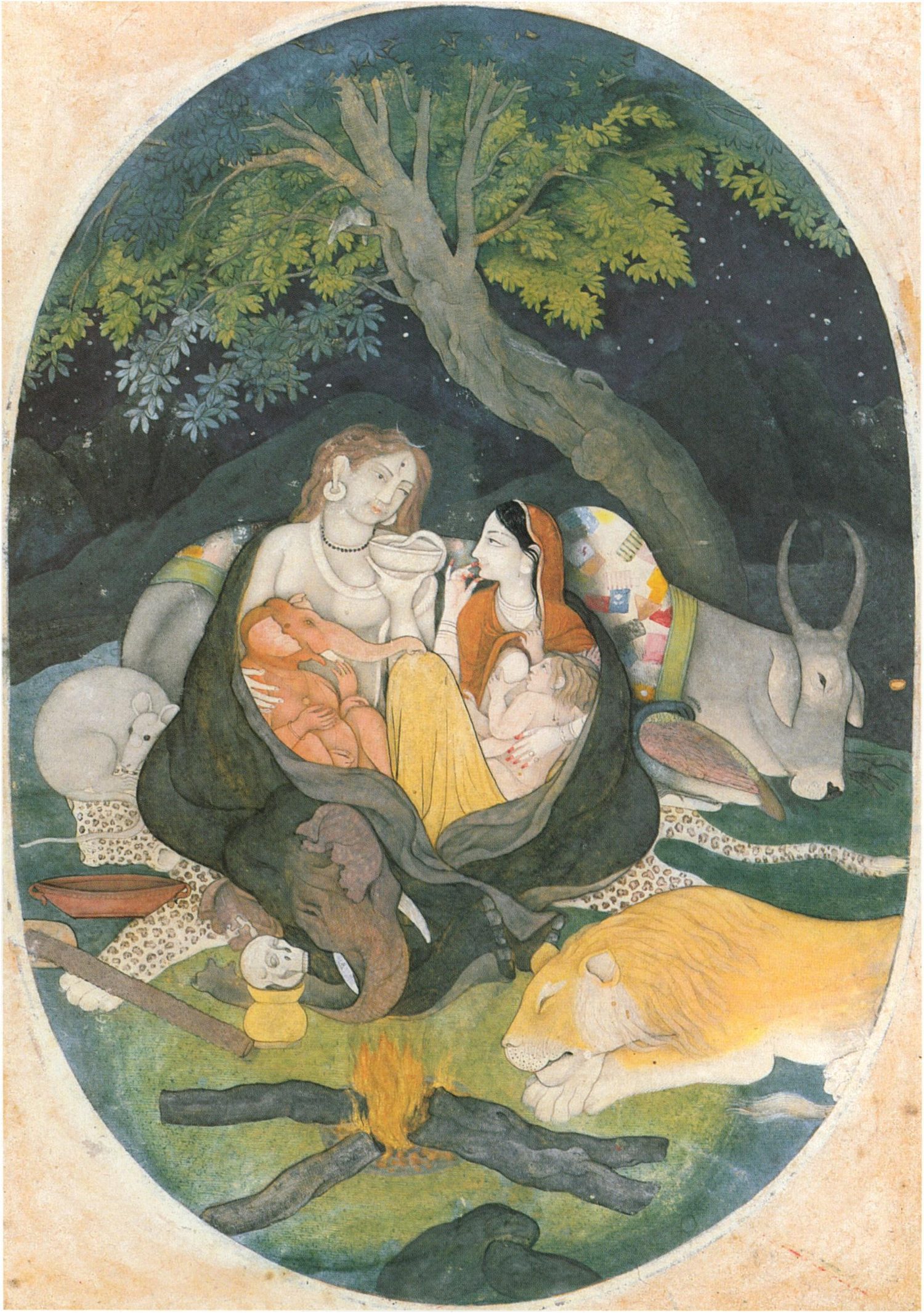
Shakti: the goddess at his side शक्ति
For Shaivas, Shiva and Shakti are one being seen from two sides: awareness and power, stillness and movement. The goddess is not simply a wife. In the Shakta traditions she is the supreme reality herself, and Shiva depends on her.
The Puranas tell her story through many names. Some are one goddess at different moments of the story; others are her fierce or nourishing forms. Texts do not always agree on how the forms relate, so the readings below are those most widely told.
Sati सती
Daughter of Daksha and Shiva’s first wife. After her death in her father’s sacrifice, tradition holds that the places where parts of her body fell became the Shakti Pithas, numbered differently in different texts, often as 51 or 52.
Parvati पार्वती
Sati reborn as the daughter of the mountain, Himavat, and Mena. Her long penance in the Himalaya won Shiva back. Kalidasa’s Kumarasambhava tells her story in some of the finest Sanskrit poetry.
Uma उमा
One of her oldest names. In the Kena Upanishad, Uma Haimavati, the shining daughter of the Himalaya, appears to Indra and teaches him about Brahman. It is among the earliest appearances of the goddess beside Shiva’s world.
Gauri गौरी
The fair one. A well-known story tells that Shiva teased Parvati for her dark skin; she did penance and shed it, becoming golden. In the Devi Mahatmya a goddess named Kaushiki comes out of her body instead, and Parvati turns dark. Both versions are told.
Durga दुर्गा
The warrior goddess who killed the buffalo demon Mahisha, made from the combined power of all the gods. The Devi Mahatmya, which scholars date roughly to the 5th–7th century, praises her as the supreme power, not only as Shiva’s consort.
Kali काली
The dark goddess who springs from the brow of the angry goddess in the Devi Mahatmya. In later images she stands on Shiva lying still beneath her: power cannot act without awareness, and awareness without power lies like a corpse.
Annapurna अन्नपूर्णा
The goddess full of food, worshipped in Kashi. Tradition holds that Shiva, the beggar, holds out his bowl to her, and that no one in her city goes hungry. Her temple stands close to Kashi Vishwanath.
Ganesha गणेश
Ganesha is lord of the ganas (Ganapati), remover of obstacles and the first god honoured in any rite. The Shiva Purana tells that Parvati made him from the paste of her body to guard her door. Shiva, not knowing him, cut off his head, and then restored him with the head of an elephant. The Brahmavaivarta Purana says instead that his head was lost to the gaze of Shani.
Historians see Ganesha rise to wide worship around the 5th to 6th century CE, after which his image appears in temples across India.
Elder or younger? ज्येष्ठ या कनिष्ठ
Tradition differs by region. In much of North India, Kartikeya is the elder son and Ganesha the younger. In the South, Ganesha (Pillaiyar) is usually the elder and Murugan the younger.
The race around the world परिक्रमा
Shiva and Parvati offered a prize to the son who first went around the world. Kartikeya set off on his peacock; Ganesha walked around his parents, saying they were his world. In Tamil telling the prize was a fruit of wisdom, and Murugan left in protest for Palani.
Wives or none रिद्धि-सिद्धि
In the North, Ganesha is married to Riddhi and Siddhi (Buddhi and Siddhi in the Shiva Purana). In much of the South he is a bachelor.
Mount and emblems मूषक
He rides a mouse, holds a goad and noose, carries a sweet modaka and has one broken tusk. Tradition holds that he broke the tusk to write down the Mahabharata as Vyasa spoke it.
Kartikeya, Skanda, Murugan कार्तिकेय
The second son was born to defeat the demon Taraka, who could only die by a son of Shiva. Shiva’s fiery seed was too hot to hold. Agni carried it, then Ganga, until it came to rest in a lake of reeds (Saravana), where a child was born.
Six star-mothers, the Krittikas (the Pleiades), nursed him, and he grew six faces to drink from all six. So he is Kartikeya, son of the Krittikas, and Shanmukha, the six-faced. As Skanda he appears on Kushana coins of the early centuries CE; as Murugan he is praised in early Tamil poetry.
Skanda the general स्कन्द
Commander of the army of the gods (Senapati, Mahasena). He rides a peacock and carries a spear. North and West Indian tradition often holds him to be a lifelong bachelor.
Murugan मुरुगन
The young, beautiful god of the Tamil hills, with the vel (lance) and the rooster banner, married to Valli, a hill-tribe girl, and Devasena (Deivanai), daughter of Indra. The Tirumurugarruppadai is a poem guiding pilgrims to his shrines.
Arupadai Veedu छह धाम
Six sacred abodes in Tamil Nadu: Thiruparankundram, Tiruchendur, Palani, Swamimalai, Thiruthani and Pazhamudircholai. Palani, on a hill, is where tradition says he went after the fruit contest.
Swaminatha स्वामिनाथ
At Swamimalai, tradition says the boy Murugan explained the meaning of Om to his father, who listened as a student. Hence the name Swaminatha, teacher of the lord.
Kartik Swami कार्तिक स्वामी
A ridge-top temple above Rudraprayag, one of his few shrines in the Himalaya. Garhwal tradition holds that Kartikeya offered his bones to his father here.
Daughters and regional children अन्य संतानें
Beyond the two sons, several regions honour other children of Shiva. These come from particular texts or local traditions, not the whole tradition, and are labelled as such.
Ashokasundari अशोकसुन्दरी
In the Padma Purana, Parvati, lonely on Kailash, wishes on the wish-granting tree and a daughter appears to take away her sorrow (shoka). She later marries King Nahusha. She is little known outside this text.
Manasa मनसा
The serpent goddess of Bengal, Assam and Bihar. The Bengali Manasamangal poems call her a daughter of Shiva, born from his seed, and tell how she won the worship of the merchant Chand and how Behula brought her husband back from death.
Jyoti ज्योति
A goddess of light honoured in parts of Tamil Nadu and North India as a daughter of Shiva and Parvati, said to have come from Shiva’s radiance. Some link her with the flame goddess of Jwalamukhi. Accounts vary widely.
Ayyappa अय्यप्पा
In Kerala, Ayyappa or Dharma Shasta is the son of Shiva and Vishnu in his female form Mohini. His shrine at Sabarimala draws millions each winter.
Andhaka and Jalandhara अन्धक
Two demons whom some Puranas call Shiva’s offspring: Andhaka, born blind from a drop of sweat when Parvati covered Shiva’s eyes, and Jalandhara, born from the fire of his anger. Both were later slain by him.
These children belong to particular texts or regions; most Puranas name only Ganesha and Kartikeya as the sons of Shiva and Parvati.
Nandi नन्दी
Nandi is Shiva’s mount, his door-keeper and the chief of his ganas. As Nandikeshvara he is also a teacher: Tamil Shaiva lineages trace their knowledge from Shiva through Nandi, and a well-known text on gesture in dance, the Abhinaya Darpana, carries his name.
Older images and texts sometimes show Nandi as a bull-headed man, his form as a gana, rather than as a bull.
Son of Shilada शिलाद पुत्र
The Shiva Purana tells that the sage Shilada did penance for a deathless son and found the child Nandi while ploughing a sacrificial field. Shiva made him immortal and married him to Suyasha.
Lepakshi Nandi लेपाक्षी
One of the largest monolithic Nandis in India, carved from a single granite boulder in the Vijayanagara period, roughly the 16th century.
Thanjavur Nandi तंजावुर
A huge Nandi in its own pavilion before the Brihadishvara temple. The present figure is usually attributed to the later Nayaka rulers rather than the Chola builders.
Whispering to Nandi कान में प्रार्थना
Many devotees whisper their wish into Nandi’s ear, trusting him to pass it on, since he never takes his eyes off his lord.
The ganas: his host of followers शिव के गण
The ganas are Shiva’s companions: dwarfish, pot-bellied, often comic, sometimes frightening. They sing, play drums and fight for him. They include ghosts, goblins and beings no other god would keep, which is why Shiva is called Bhutanatha and Pramathanatha, lord of spirits and of the pramathas.
Bhringi भृंगी
A sage who wished to worship Shiva alone and circled him like a bee, refusing to circle Parvati. She drew the strength out of his body, leaving him bones; Shiva gave him a third leg to stand. In some tellings Shiva then became Ardhanarishvara, so the two could not be parted.
Chandesha चण्डेश्वर
A cowherd boy, Vicharasharman, who bathed a sand linga with the milk of the cows he tended. When his father kicked the offerings aside, the boy struck him with an axe. Shiva made him steward of his household. He is one of the 63 Nayanar saints.
Virabhadra वीरभद्र
The fiercest of the ganas, born of Shiva’s anger to destroy Daksha’s sacrifice. He leads the host in battle, often with Bhadrakali at his side.
Kubera कुबेर
Lord of wealth and king of the yakshas, who lives at Alaka near Kailash. Tradition makes him Shiva’s friend and neighbour, made guardian of the north after his devotion.
Pramathas प्रमथ
The tormentors, troops of Shiva’s attendants named in the epics and Puranas. They stand guard in temple friezes and dance along plinths.
Bhutas भूत
Spirits, ghosts and beings of the cremation ground. Shiva takes in those whom others shun. In Garhwal and Kumaon, many local guardian spirits are worshipped as his ganas.
Kirtimukha कीर्तिमुख
A monster born of Shiva’s anger who, told to eat, devoured his own body. Shiva named the face that remained the face of glory and set it above temple doors.
Where Shiva lives शिव के धाम
Tradition gives Shiva homes at both ends of life. He lives on the snowy mountain far from the world, and in the burning ground where the world ends. Between them is Kashi, the city he never leaves.
Kailash कैलाश
The Puranic Kailash is a heavenly mountain north of the Himalaya, with Lake Manasa at its foot, Kubera’s city Alaka nearby and Shiva and Parvati seated at the top. Pilgrims identify it with the peak in Tibet.
Kashi as Avimukta अविमुक्त
Avimukta means never forsaken. The Kashi Khanda of the Skanda Purana says Shiva never leaves Kashi, even at the end of an age, when he holds the city up on his trident.
Manikarnika मणिकर्णिका
The great burning ghat of Kashi. Tradition says an earring of Shiva or Parvati fell here, and that Shiva whispers the Taraka mantra into the ear of everyone who dies in Kashi, freeing them.
Cremation grounds श्मशान
Shiva is Shmashanavasin, dweller in the burning ground. Fire turns the body to ash, and he wears it. Mahakaleshwar at Ujjain is famed for its dawn aarti with ash.
Kedar केदार
The Kedarkhand of the Skanda Purana calls Garhwal one of his dearest homes, the field where he hid as a bull and stayed in five places.
Sources
- Shiva Purana, Rudra Samhita (Sati and Parvati Khandas, Kumara Khanda) and Shatarudra Samhita 6–7
- Devi Mahatmya (Markandeya Purana 81–93)
- Kena Upanishad 3–4
- Kalidasa, Kumarasambhava
- Padma Purana, Bhumi Khanda (Ashokasundari)
- Brahmavaivarta Purana, Ganapati Khanda
- Skanda Purana, Kashi Khanda and Kedarkhand
- Sekkizhar, Periya Puranam (12th century)
- Tirumurugarruppadai (Sangam-era Tamil poem)
- Bijay Gupta and Ketakadas, Manasamangal kavya (Bengali, c. 15th–17th century)
- Paul B. Courtright, Ganesa: Lord of Obstacles, Lord of Beginnings (1985)
- Fred W. Clothey, The Many Faces of Murukan (1978)
- Diana L. Eck, Banaras: City of Light (1982)
- David Kinsley, Hindu Goddesses (1986)
Traditional accounts are presented as tradition. Dates are approximate ranges used by scholars.